
By Payton Turkeltaub
Medill Reports
From the day the first Build-A-Bear Workshop store opened in the Saint Louis Galleria Mall in 1997 to a line around the corner of parents and children waiting to be the inaugural customers, founder and former CEO Maxine Clark knew she had done something right.
A month later, it was confirmed again as families flocked to the store with intrigued parents, “literally throwing (their) business cards at me,” Clark said. And again when Clark would hear customers discussing who owned the business, assuming Disney or Warner Bros. had bought the company. “I’m listening to this in line, and I’m thinking, ‘we’ve done it,’” Clark said.
But despite how many stuffed animals the company sold or how packed the stores were with customers, Build-A-Bear was never free from skepticism, explained Clark. Cynics questioned whether the brand’s popularity would last or be a short-lived fad. They wondered what age group the store was really for, how customers could justify the price and whether kids even wanted to make their own furry friends in the first place. They even said parents would drop their kids off at the local Build-A-Bear store, expecting the Bear Builders – the official title of the company’s sales associates – to babysit. How successful could an experiential retail store be?
Truthfully, Clark didn’t have the answers to all those questions either. But at the time, she’d been in retail for more than 20 years, serving as the president of Payless ShoeSource and the executive vice president of Venture Stores, among other roles. She’d written out a 10-year business plan — titled the “Beary Good Business Plan” — and consulted with her board of directors, which at that time consisted of her neighbors’ children, Katie and Jack. More than anything, though, she was willing to take a risk.
“I think most people didn’t expect us to last that long,” she said. “Maybe 10 years.”
This year, it’s been 28 years since the first store opened and 21 years since the company went public. Since then, Build-A-Bear has weathered economic downturns and shifting consumer tastes to ultimately come out on the other side of what analyst Keegan Cox of D.A. Davidson & Co. calls a “10-year turnaround,” becoming one of the highest growing companies in the specialty retail industry. As of 2025, it’s riding higher than ever — the company has opened more than 600 retail locations worldwide, delivered record-breaking first quarter earnings, including an 11.9% year-over-year revenue jump, and seen its stock surge to an all-time high of $75.62 on Sept. 15. As of Aug. 28, Build-A-Bear reported its most profitable second quarter in the history of the company with more than $124 million in total revenue.
But how has an experiential retail brand not just endured, but also thrived, in a notoriously volatile industry? The answer, it turns out, is adapting.
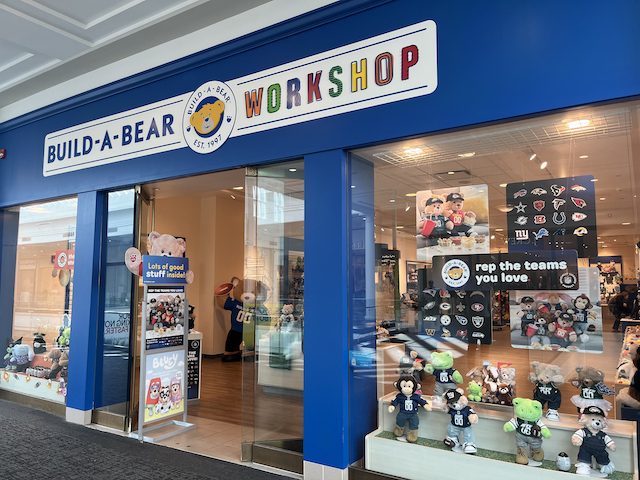
Build-A-Bear was initially introduced to the masses as a first-of-its-kind retail experience in the late 1990s. Each “workshop,” then exclusively in malls, allowed customers to take part in an interactive build-it-yourself process through which they could personalize a “furry friend,” complete with its very own birth certificate, with scents, sounds, stuffing and a heart.
For the first seven years, with Clark at the helm, this focus worked; stores continued to open and generate a profit. “(Malls) really wanted Build-A-Bear,” Clark said. “They begged us to come.”
But while the brand was soaring, the business was not. Following its IPO in 2004, and the 2008 recession, the company’s profit margins began to shrink; Between the first quarter of 2005 and the first quarter of 2008, Build-A-Bear Workshop’s total profit fell 20%, according to data from the company’s earnings reports. From 2005 to 2007, the stock price was hovering between $20 and $30; by Oct. 24, 2012, it had fallen to less than $4. In 2013, the company recorded a net loss exceeding $2 million.
“There were the business headwinds of malls declining,” said Gary Schnierow, vice president of investor relations and corporate finance at Build-A-Bear. Often described as a “mall-based retailer,” at the time the company was largely dependent on these shopping centers; according to annual financial filings, as of December 2012, nearly 300 of the 351 company-owned retail locations were primarily situated in major malls throughout the United States, Canada and Puerto Rico
In 2013, Sharon Price John took over for Clark as CEO. Price John had been in the toy industry, coming from companies like Hasbro and Mattel. Under her direction, the company transformed from a mall-based retailer to an international brand. She began by right-sizing retail locations, closing close to 50 stores. But she also expanded product offerings, including new partnerships with franchises such as Pokémon and “Star Wars” to produce exclusive plush toys, and a new e-commerce business model that opened the business up online. In 2014, she brought in Voin Todorovic as chief financial officer, formerly of Wolverine Worldwide and Limited Brands. That year, the company earned $14 million in profit, peaking at $27 million in 2015. By 2017, the company had solidly returned to profitability.
However, even before Price John stepped in as CEO, the Build-A-Bear brand never wavered. It’d become known for its original plush designs, the uniqueness of the retail stores — in the early days of the company, Clark said, they negotiated with landlords to be the “only experiential stuffed animal store in the mall” to protect against competition — and the fun experience that was making your own. But the business side was what needed a redesign. “Strong brands need a strong business model,” said Susan Fournier, dean of Boston University’s Questrom School of Business. “You can’t have one without the other.”
And while the business foundation was relaid in those years, external factors obscured those key strategic initiatives. First, in 2019, Brexit impacted around 20% of the business that’s in the UK. Then in 2020, the COVID-19 pandemic made it impossible for visitors to shop in-person at Build-A-Bear, limiting a core tenant of the business’ revenue generation. This is why the company’s turnaround has “really accelerated,” since, Cox said.
“If you look at pre-COVID, the company was marginally profitable,” Schnierow said. “The company didn’t have the money to spend on growth initiatives, and management was so busy trying to get to profitability, fixing the company. They didn’t have the bandwidth to focus on growth. The last four years, we’ve been profitable. A lot of cash flow problems have been fixed. We’ve had the money, finally, to spend on growth.”
While these behind-the-scenes shifts may not be immediately apparent to all investors or analysts, what is evident is Build-A-Bear’s storing stock — since 2020, it has gained more than 2,200%, according to its stock history.
One of the business areas responsible is the company’s partner-operated stores, which have become the fastest growing piece of the business, according to Shnierow. From the launch of these locations in the 2010s to 2018, 39 had opened; as of 2024, there are 138 partner stores.
While the traditional retail store margins have gone from low single digits to north of 25%, these partner-operated stores offer an even lower-risk, higher-reward option for expansion.
“The partner is taking on most of the risk,” Cox said. “All Build-A-Bear has to do is give them the Bear Builder – the stuffing machine – and signage. Because of that, it’s a lower investment, and they’re able to get better returns on it.” In 2023, Build-A-Bear opened its first international partner-operated store in Italy and has since opened another 14 within the country.
“Teddy bears are international,” Schnierow said. “So (there is) an opportunity.”
In recent years, the growing consumer trend of what the company refers to as the “kidult” market has aided growth as well — more than 40% of the company’s revenue is coming from teens and adults, whom the brand defines as 16 and up.
“When you’re thinking of a children’s business, the children don’t have the end purchasing power,” Cox said. “Now, with teens and adults making their own purchases, it makes the business more stable.”
This age demographic also opened up the gifting and collectible market for the company. With limited, online-only drops, more and more adults are clamoring to get their hands on exclusive collaborations and popular items. It’s a strategy that works; according to the company’s second quarter earnings report, e-commerce demand increased more than 15%, compared with the same time frame last year.
Spring Green Frog, a fluffy friend that first went viral three years ago on TikTok, is one of those sought-after items. “They couldn’t keep that thing in stock,” said Eric Beder, CEO of Small Cap Consumer Research. Katie Tietyen, 31, who collects Build-A-Bears, first began her collection in 2020 when the brand released exclusive plushies for the movie “Trolls World Tour.” “Build-A-Bear was coming out with some ‘Troll’ plushies,” Tietyen said. “They were definitely the best-looking plushies, so I knew I needed to get them.”
Tietyen first visited a Build-A-Bear store after seeing a commercial on TV as a child. “I’ve always been a stuffed animal person, so I really wanted to go,” she said. “My grandma took me once, and I’ve loved it ever since.”
Tietyen’s journey with the brand is one representative, largely, of their customer base; most customers first come to Build-A-Bear as a child. But in the 28 years since, those children have now grown up, creating a new generation with an affinity for the brand. “If you have kids, you’ll want to take your kids to Build-A-Bear,” said Schnierow.
This business model is one that brands often strive to achieve – though it’s a hard thing to do, notes Krystine Batcho, a psychology professor at Le Moyne College. “(They) hope that then when those children grow up, if they’ve had a good experience with the service or the product or the activity, they’ll pass it on to the next generation,” Batcho said. “That’s what makes for longevity in business.”
And although some investors and analysts are still wary of malls, 80% of visits to Build-A-Bear stores are planned — meaning the brand is one of the last few retailers actually driving traffic to them. “We have a lot of people who are very skeptical of mall-based retailers,” Beder said. “I always tell them, go to your local Build-A-Bear on a Saturday or Sunday and just watch. Watch for about an hour, and you’ll realize that it’s a huge piece of this business.”
“The experience of taking your toddler, your child, to the mall to have a furry friend made for him or her, specifically in front of them, and they see it done. There’s a magic to that,” Beder said. “The true customer comes back again and again. They’re coming back for that experience, for their grandchild, or for their daughter or their son, or a family member that says they’ll remember. … You can’t recreate that online.”
Payton Turkeltaub is a recent graduate of Northwestern’s Medill School of Journalism. You can see more of her work here.