
By Emma Urdangen
Medill Reports
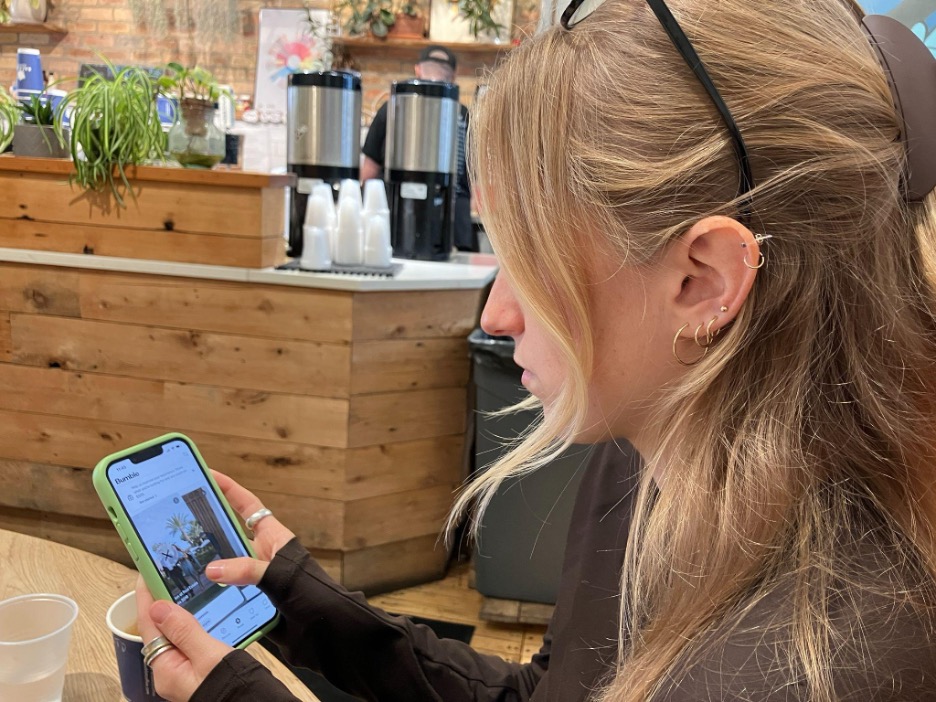
Walking out of a Washington, D.C., dive bar after her fifth terrible app-date of the month, 23-year-old Carly HoganBruen knew something wasn’t working.
That night, “David” took a 20-minute call during dinner to chat with his sister, then ended the date early. The week before, “Mark” said he “couldn’t stop smiling” at drinks, then texted they were “on different life paths.” And the month before, “Chris” started browsing happy-hour spots with her, then ghosted mid-planning.
“Guys will swipe on you and then realize, ‘Oh my gosh, there’s 100 other girls in like a 5-mile radius that I could go on a date with,’” she said. The constant cycle of matching, chatting and ghosting left her with what she called “insane trust issues.”
So, she started her own in-person dating events service and “unmatched” the dating app scene for good.
“We’re sick of guys being jerks to us,” she said.
HoganBruen isn’t alone. In fact, dating app fatigue is showing up broadly in the stock market, with Bumble having taken a particularly large hit.
In June, after a 91% stock price plummet since its peak in 2021, Bumble laid off 30% of its workforce.
“Lowering headcount is often an easy way to improve profit margins,” said Nick Laudati, an assistant controller at JAT Capital. “If you can’t increase revenue, the next best strategy is to cut expenses.”
Beyond improving margins, the market saw the layoffs as a sign Bumble was serious about turning things around. The company’s cost-cutting move, expected to save Bumble $40 million annually, triggered a 27% stock recovery.
“They announced the layoffs, but they also adjusted up their guidance for revenue and EBITDA (earnings before interest, taxes, depreciation and amortization),” said Wes Harrell, a Match Group trader. “They’re making more money while saving $40 million a year — this is kind of a no-brainer for investors.”
But for the millions of users demoralized by endless swiping and costly paywalls, the real question isn’t whether Bumble can bounce back financially; it’s whether dating apps can still deliver on their original promise of meaningful connection.
The company, whose motto — “Here, kindness is sexy, you being you is perfect, and women come first. Always.” — once promised to revolutionize dating by putting women in control, now fights for relevance in an industry where users are increasingly burned out and competitors are winning the match.
Bumble’s cultural rise and fall
Founded in 2014 by Whitney Wolfe Herd, Bumble launched as an antidote to the often toxic dating scene found on other apps. Women controlled the conversation, literally: In heterosexual matches, only women could initiate a chat.
“For all the advances women had been making in workplaces and corridors of power, the gender dynamics of dating and romance still seemed so outdated,” Herd wrote in a statement for Bumble. “I thought, what if I could flip that on its head? What if women made the first move, and sent the first message?”
The unconventional concept won over millions of users, especially younger women, and helped Bumble differentiate itself from competitors like Tinder, the hookup-heavy Match Group app.
By the time Bumble went public in 2021, it was valued at more than $7 billion. At any given college bar, young women wore yellow sunglasses, sported bee-themed pins and carried signs reading “Make the first move” and “Join the hive.”
Dating app user Tori Palm remembers the campus buzz surrounding Bumble’s spirited marketing. “It definitely brought more recognition and awareness to the app,” she said.
But fast-forward to 2025, and users no longer feel the same sting of excitement. Relationship coach Jaime Bronstein, who works with single people navigating dating apps, said the core issue isn’t technical, it’s cultural.
“The biggest problem is that it’s so easy to meet someone, but it’s not easy to meet someone special,” Bronstein said. “There’s this culture of ‘people are disposable’ and people aren’t giving others enough of a chance.”
Mohanbir Sawhney, a Northwestern University Kellogg School of Management marketing professor, calls this the “cocktail party syndrome.”
“Users are all looking over your shoulder saying, ‘Is there somebody more interesting I could be speaking with right now?’” he said. There’s a “seductive promise” of connection and abundance, but with endless options comes a hesitancy to commit, in which case, the apps are rendered ineffective, Sawhney said.
Palm said she can feel this syndrome while swiping, and she’s tired of matches that never make it past small talk.
“Some people could be using these apps to just chat with someone online,” she said. “That’s not what I’m interested in doing. I actually want to go on a date and get to know someone.”
For many, this behavior strikes a nerve.
“A guy will say I’m the only one he’s talking to, he can see a future with me and he is only interested in dating me, then proceeds to ghost me the next day,” HoganBruen said. “So now I have my walls up,” she said.
As user sentiment sours, Bumble struggles to maintain its competitive advantage. When Bronstein asks clients about app preferences, the answer is consistent: Hinge.
“I think Bumble is like becoming more of the Tinder, cheesy pickup bar,” she said.
Sawhney said he thinks this perception shift comes from Bumble’s attempt to broaden its market appeal. In the aftermath of its stock decline, the company moved away from its original mission of “fostering female-empowered lasting relationships” and instead introduced the option for men to make the first move — if they pay, of course. He described this expansion as a “fool’s errand,” arguing that it diluted their brand identity.
Elle Wilson, a dating coach and founder of the dating events company “Met Through Friends,” said the dating world is noticing this shift.
“It’s turned into another big dating app as it captured market share,” she said. “It lost its novelty.”
The paywall paradox
But, in a market full of Hinges, Tinders and the niche dating app of the day, Bumble needs to find ways to grow revenue. For Bumble, that looks like subscription tiers that some users begrudge.
“I don’t feel like paying if it’s more of a hookup culture and dead ends,” HoganBruen said.
Ex-Bumble user Ashley Chandler framed her frustration more bluntly: “Do I really need someone that bad that I’m gonna pay monthly to see who liked me?”
Wilson’s clients tell her that frankly, they’re sick of it. “I hear frustrations of ‘I used to be able to get good matches on the free version, and now they’re hiding all my good matches behind a paywall,’” she said.
The numbers reflect this resistance. Bumble’s second quarter report for 2025 revealed its total paying users fell 8.7% from 4.1 million to 3.8 million in the past year, and its revenue decreased 7.6% from $268.6 million to $248.2 million in that same timespan. Bumble is struggling to convert more users into more revenue, because “people are unwilling to pay for premium features if they weren’t before,” Harrell said.
Some experts suggest a radical approach to this financial conundrum: deliberately shrinking the user base. Sawhney said Bumble should stop saying they’re about “meeting people” and start saying they’re about “meeting better people.”
He proposed a “closed network,” or a method of restricting access to users based on certain criteria. Whether that be a recommendation from a friend or users signing a conditional waiver of entry, Sawhney said the accountability of closed networks could reduce the disposability problem burdening apps like Bumble. He pointed to platforms like “Northwestern.love,” which requires a university ID to join, as a potential model.
Or, he said, let’s up the ante. “Raise prices, but raise value. Get rid of the riffraff, who are the freeloaders,” he said. As a result, users will have a stake in the game and feel committed to the process. He suggested premium concierge services, similar to high-end matchmakers who charge thousands of dollars.
In response to Chandler’s original lament, Sawhney argued steep costs might be worth it. “Would you pay $2,000 for a casual hookup? Maybe not,” he said. “But would you pay $2,000 to meet the partner for life? That’s a different question.”
Stock market recovery
If you ask the investors, though, Bumble’s recent moves signal hope. The company is hoping that a simplified structure and renewed focus on product development will boost profits and improve customer satisfaction. In its latest outlook, Bumble projected third quarter revenue between $240 million to $248 million, and adjusted EBITDA between $79 million and $84 million.
The market appears to be rewarding what analysts see as “operational discipline and margin recovery,” according to Zacks Investment Research. A lot of the positive response comes from Bumble’s commitment to investing its savings into product improvements, particularly AI features geared toward more compatible match-ups.
However, Zacks said “lingering user monetization challenges, flat growth in paying users and doubts about Gen Z adoption still remain headwinds.” So, while the cost-cutting makes sense on paper, it doesn’t fix the actual issue: user engagement.
So what’s next?
Wall Street might be celebrating Bumble’s expense reduction and stock recovery, but the factors users say they care about — trust, effort and the platform’s commitment to women — don’t show up in quarterly earnings reports.
Analysts and relationship coaches agreed the company needs to win back the cynical and burnt-out daters for a shot at bouncing back. Part of that, Sawhney said, is proving Bumble is focused on creating a user base genuinely invested in empowerment and meaningful connections. “What you want is the relational people, not the transactional people,” he said.
HoganBruen now hosts her events in the same D.C. neighborhood where she endured those five dire dates. Bumble’s challenge, experts said, is convincing users like her to rejoin the hive — one where the “Chrises” have buzzed off for good.
Emma Urdangen is a recent graduate of the Medill School of Journalism.