
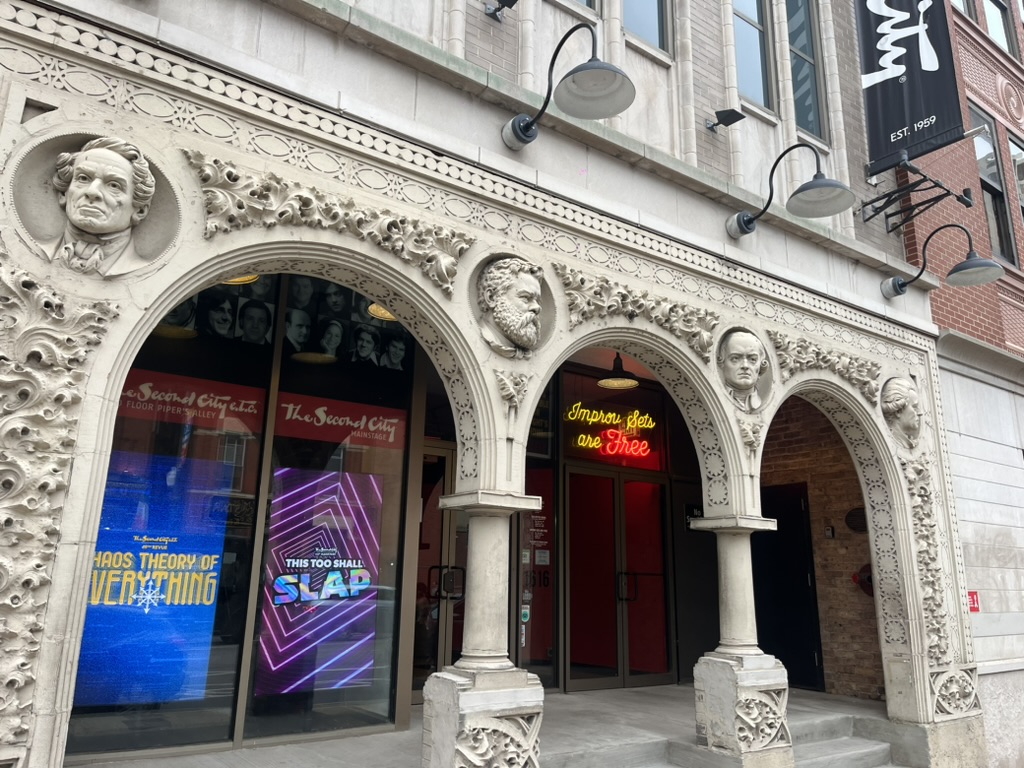
Yes, the funny business that launched Tina Fey, Stephen Colbert and Tim Meadows challenges power onstage. And today, the comedy theater is striving to reflect that offstage as well.
By Emma Urdangen
Medill Reports
A scene from The Second City Chicago’s recent mainstage show “The Devil is in the Detours” features an apparent father and daughter playing in an arcade. The girl seems to be begging her dad for more tokens, but it turns out she’s representing Israel, and she is begging the U.S. for more money for weapons.
Controversial commentary and strong reactions to it are par for the course for the 65-year-old theater, said Kelly Leonard, vice president of creative strategy at The Second City Chicago.
“We’ve had audience members rush the stage in anger during this show,” Leonard said. “It’s always been about challenging power.”
Historically, the training ground for comedy legends such as Amy Poehler, Tina Fey and Keegan-Michael Key embraces social and political controversy onstage. “It’s kind of an obligation,” said Mick Napier, a Second City director since 1990.
But backstage, sometimes, The Second City struggled to prioritize social equity over turning a profit, said Anne Libera, the former artistic director and current touring company director. Today, the baby boomer organization’s leadership is trying to shift its culture.
“If we want to be equitable, we have to be institutionally systemic about it,” Libera said.
In December 1959, Paul Sills, Bernie Sahlins and Howard Alk founded The Second City Chicago as a “rebel leftist reaction to what was happening in the world,” according to Napier.
Since its first show or “revue,” “Everybody’s in the Know,” with 120 audience members paying $1.50 each, the company has expanded to include touring, E.T.C., and mainstage ensembles. Today, the mainstage theater seats 290, with tickets costing up to $75.95.
Through this growth, Leonard said, each ensemble maintains Sahlins’ motto at the center of their work: “always play to the top of their intelligence and never assume the audience is stupid.”
Despite changes in ownership, the company’s commitment to comedy that confronted social issues remained constant. In 1974, Sahlins sold the company to television producers Andrew Alexander and Len Stuart. Under their leadership, this approach continued.
Leonard produced a sketch from the 1995 revue, “Piñata Full of Bees,” with Adam McKay, which had Noam Chomsky teaching third graders about “the real America.” The students in the scene left class crying after learning about the Native American genocide. A decade later, in Napier’s 2005 show, “Iraqi Break,” Stephen Colbert performed a song, “Our God is better than your God,” about religious tension during wartime.
“Dealing with current social and political events is sometimes a creative burden,” Napier said. “I’ve had to make casts read the newspaper.”
Similar sketches receive more audience pushback since President Donald Trump’s election, Leonard said. “It’s a troubling shift toward zero-sum thinking, which makes the work more important than ever.”
At the historically straight, white and male-dominated theater, Alexander “pushed ‘diversity’ before I’d even heard that word,” Napier said. After the 1992 Los Angeles riots, Libera said Alexander realized they couldn’t comment on relevant issues with their current makeup.
They adjusted their casting, hired a director of diversity and inclusion, and began hosting Black History Month shows. In 2014, the company implemented the Bob Curry Fellowship, designed to train comedians of color. The fellowship is named after the first Black comedian to join The Second City’s resident company.
“In many ways, Andrew’s heart was in the right place,” Libera said. “But as a popular art form, comedy is about money.”
The casts gradually shifted from “five guys and one woman” to “maybe four guys and two women with one person of color,” said Andy Eninger, former writing program director and performer. This made finding an understudy difficult for that one member and discouraged them from taking days off, he said. And, he added, at the time, there was no HR system to raise a red flag.
In 1996, the first equal gender show “Citizen Gates” opened, featuring Fey and directed by Napier.
As a gay person, Eninger said he thought he’d never get on stage. He remembers playing “freeze tag,” an improv game in which a scene starts from a frozen pose.
“I was constantly put in, like, blow job positions,” Eninger said. “Like ‘gay sex is funny.’…You had to just laugh. You couldn’t name it.”
He admired Martin Garcia, one of the first gay performers he saw onstage. “He was unabashedly himself,” Eninger said. “(It) helped change the temperature.”
In 2014, Alexander hired his son Tyler Alexander and Stuart’s son Darcy Stuart as producers, turning the theater into a family business.
Two years later, in November 2016, Tyler Alexander co-produced “A Red Line Runs Through It,” directed by Matt Hovde. With just one white man in the cast, Scott Morehead, the show “was meant to be a new, confrontational commentary on race,” Libera said.
But the primarily white, Old-Town-resident and tourist-filled audience, each paying up to $75.95 for their tickets, didn’t change. The show ran during Trump’s first candidacy, and the crowd started offering racially targeted suggestions during the audience interaction section.
The cast felt unsafe, the house staff didn’t know how to intervene, the actors fought and the show’s management failed to fully grasp the matter they were selling on stage, Libera said. In one instance, the cast proposed a show fundraising for Black Lives Matter, and the company agreed on the condition that half the proceeds go to the Chicago Police Department, former cast member Dewayne Perkins tweeted.
The show resulted in Morehead’s suspension and his suing of the company for racial harassment. Alexander took a leave of absence, and actors Lisa Beasley and Aasia Lashay Bullock quit, with Bullock tweeting the company forced her resignation. Despite the controversy, the revue received a Jeff Award nomination for theater excellence in Chicago.
Today, the entertainment industry oftentimes provides resources to actors, such as on-set counselors or intimacy coordinators when tackling traumatic material. During the 2016 Second City show, the actors and producers navigated these scenarios on their own. Libera said the revue reflected the company’s underlying problem.
“We didn’t have clarity on how we were training people or what diverse voices meant,” she said. “The setup was designed not just to fail, but to cause maximum harm.”
In 2020, in the aftermath of the revue, a group of 19 Black alumni and current employees, including Bullock, Sam Richardson and Amber Ruffin, signed a letter calling for “a thorough investigation and removal of … staff guilty of microaggressions, racial transgressions, cultural appropriation, mental and verbal abuse against the Black artists.”
Andrew Alexander, then 75, stepped down, writing he “failed to create an anti-racist environment … and that is one of the great failures of my life.” Later that year, ZMC, a private equity firm, bought the company for an estimated $50 million, according to The Financial Times.
The current leadership is focusing on changing the culture in a meaningful way, Libera said. In 2020, they established a DEI council, and in 2021, staff unionized as the Association of International Comedy Educators, becoming full-time employees with a human resources department. In 2023, they launched “The Black Excellence Revue,” featuring an all-Black cast intended and intended for a Black audience.
Today, transgender performers, including E.R. Fightmaster and Ruby Aviña, perform nationwide, and creative director Tyler Dean Kemp mindfully casts the revues. He focuses on expanding opportunities beyond just a select few, Eninger said.
“But there’s still this push and pull of the art and the business,” Eninger said. The venture-capital-owned theater charges $26.25-$75.95 per ticket, and thousands of writing and improvisation students pay $365 per eight classes.
In May, The Second City staff announced they would strike under their Actors Equity Union if ZMC did not meet their wage increase requests. ZMC agreed to raise their pay, beginning with an 18% increase the first year and compounding to 40.5% over the next five years, according to WBEZ.
And the actors confidently address this push and pull onstage. In a recent Sesame Street-themed sketch, “Financial Street,” “the cast rips to shreds the new owners,” Leonard said. Adisa Williams, as the host, visits various puppets on the street — each represents a satiric point about capitalism. At the end, the puppets turn on Williams, implying she’s the real capitalist puppet because The Second City is owned by ZMC.
But the head of ZMC laughs the loudest from the audience, Leonard said. “In that position, you’re hiring artists to take shots at people in power.”
The Second City community members said they feel the impact of the organization’s recent efforts. Mugsie Pike, a nonbinary 2024 improv and sketch student, said they’ve been “pleasantly surprised” to feel comfortable and supported by teachers and peers throughout their time at the theater. “I’m glad I came when I did.”
Pike recently attended a show with a classmate, and when the cast made a “trans joke” that they thought was very funny, their friend turned to them for confirmation before laughing. “That moment represented everything I love about (The Second City),” they said. They’re making jokes about these things on the mainstage, but it’s not punching down, and my classmate supported me first and foremost.”
Yes, “When you do things the hard way, it’s hard,” Libera said. And, she added, “I think we are getting there.”
Emma Urdangen is a graduate student at Medill in the magazine specialization with a concentration in podcast journalism. You can find her on LinkedIn at www.linkedin.com/in/emmaurdangen and see the rest of her work at emmaurdangen.com.
Editor’s note, Sept. 1, 2025, 9:30 a.m.: This story has been updated to clarify that after The Second City cast proposed a show fundraising for Black Lives Matter, the company agreed on the condition half the proceeds go to the Chicago Police Department, according to a former cast member’s tweets.