
By Khaleel Rahman
Medill Reports
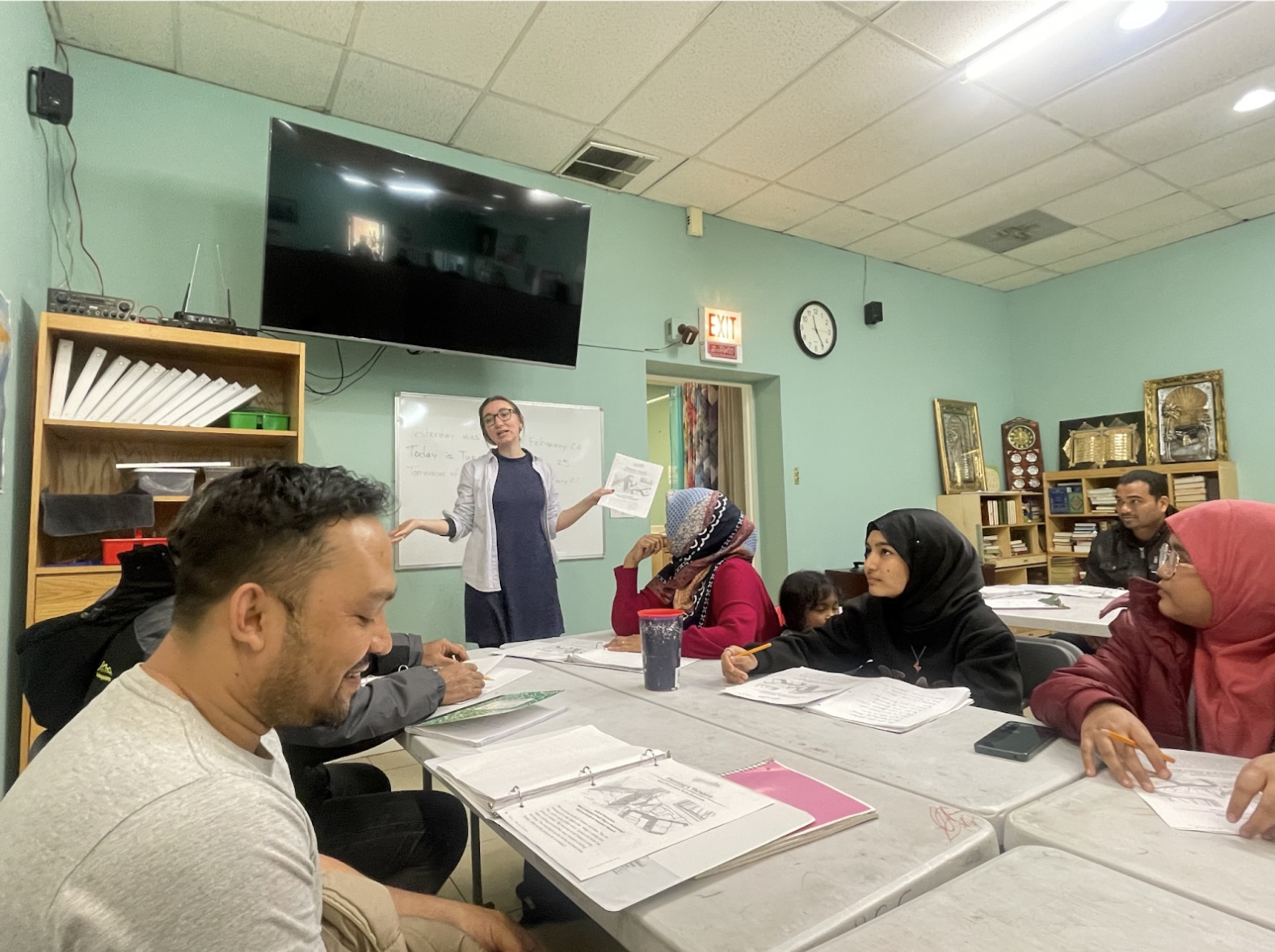
Chicago’s Rohingya Cultural Center is taking a unique approach to English as a second language (ESL) classes by tailoring courses to meet the needs and schedules of newly arrived immigrants who often don’t know how to read or write.
“RCC prioritizes teaching beginning literacy, and unfortunately, a lot of programs aren’t able to afford to teach at the beginning literacy level,” said Erika Husby, the RCC’s sole ESL instructor.
The Rohingya are an ethnic minority originating from Myanmar, which is located near China. According to RCC Executive Director Nasir Zakaria, the community in Chicago has grown to more than 800 families during the past decade.
In recent years, Rohingya from Myanmar, as well as those forcibly displaced into surrounding countries like Bangladesh, Indonesia and Malaysia have immigrated to Chicago. The RCC, located in West Ridge, was established in 2016 to serve the needs of the growing population.
According to Zakaria, the RCC launched its own ESL program because of the many barriers new immigrants faced attempting to get access to state-funded English classes.
“The first challenge they (immigrants) have is language,” Zakaria said. “So they don’t speak the language, and so it’s difficult to find a job. … It’s difficult to understand the culture here in this country, difficult to understand the law.”
The Illinois Community College Board, which funds most of the state’s ESL classes, requires prospective students take a standardized test to determine the skill level they will be placed. Only students who pass the test can be counted toward the grant metrics that determine funding for ESL courses.
Most Rohingya only use the spoken form of their native language and don’t know or use its written form. This inability to read or write poses an additional hurdle to taking the exams and registering for classes, as well as classroom learning in general.
“A lot of (state) programs, they’re not able to take in students or teach them at that beginning level, because they’re not able to count them basically towards their grant metrics,” Husby said.
State-funded ESL courses also have strict attendance policies. The 2023 ICCB Program Manual mandates students with more than five consecutive absences must be dropped from their course.
According to Husby, the lack of flexibility makes it difficult for adult learners trying to balance a job, stay-at-home parents, disabled learners or retired learners.
“People have a lot of appointments, especially when they first arrive,” Husby said. “You have to go to all these (appointments), you know, set up all your accounts or whatever, so we understand that it’s not possible for everyone to attend every single day.”
As a result of these barriers, the RCC set out to design ESL courses to accommodate the specific needs of their community.
The RCC’s ESL classes are tailored for preliterate learners who don’t know how to read or write. While students can take an informal placement test with Husby to determine if they are eligible for the intermediate or advanced levels, there is no required passing score to enroll.
Students meet for an hour and a half, Monday through Thursday. Although Husby said she encourages students to attend class as often as they can, there is no attendance requirement, which can ease the burden for adult learners.
Classes operate on open enrollment, which means new students can join at any time during the year and don’t have to wait for the start of a semester. However it does require Husby to go at a slower pace, which she believes is beneficial for students.
“The idea is not so much that every year you go up to the next level, but figuring out a little bit more of what’s your background, what’s your pace of learning,” Husby said.
The smaller class sizes of between five and 10 students allow for a more intimate and social feel. The mood of the class is often light-hearted with lots of laughing and joking around throughout the class.
“It’s just really fun because I’m just hanging out with people who are incredibly motivated, and we’re all like doing fun things together basically,” Husby said.
Rather than preparing for standardized testing, Husby tailors her lessons to help students navigate daily life.
Yusuf Hussain, a 50-year-old Rohingya immigrant from Malaysia and an RCC ESL student, said he appreciated the practical language skills he’s gained that help him in daily interactions.
“I learned in the English class how to go to the grocery (store), how to buy stuff, how to ask for what I don’t find,” Hussain said in an interview interpreted by RCC translator Aminnisa Omar.
For many in the Rohingya community, these courses are not only their first time learning English but also their first time in a classroom. Many have never had the opportunity to get a formal education and are learning how to study for the first time, which can be an adjustment. As a result, Husby advocates for a more personalized definition of student success.
“I think success looks a lot like someone feeling like they’re able to learn,” Husby said. “When you’re an adult, especially if you’ve never gone to school, you often feel like it’s not possible for me to learn … so building confidence is one of my biggest goals.”
Husby said she ultimately sees improvement in communication as a benchmark of progress.
“When I see them (students) being able to have a conversation with each other in English, even if they’re not, you know, fully able to have all the vocabulary that they need, but they have the communication strategies … I see that as a success,” Husby said.
Khaleel Rahman is a graduate student Medill specializing in politics, policy, and foreign affairs. You can connect with him on LinkedIn and follow him on Twitter at @Krahman333.