
By Layna Hong
Medill Reports
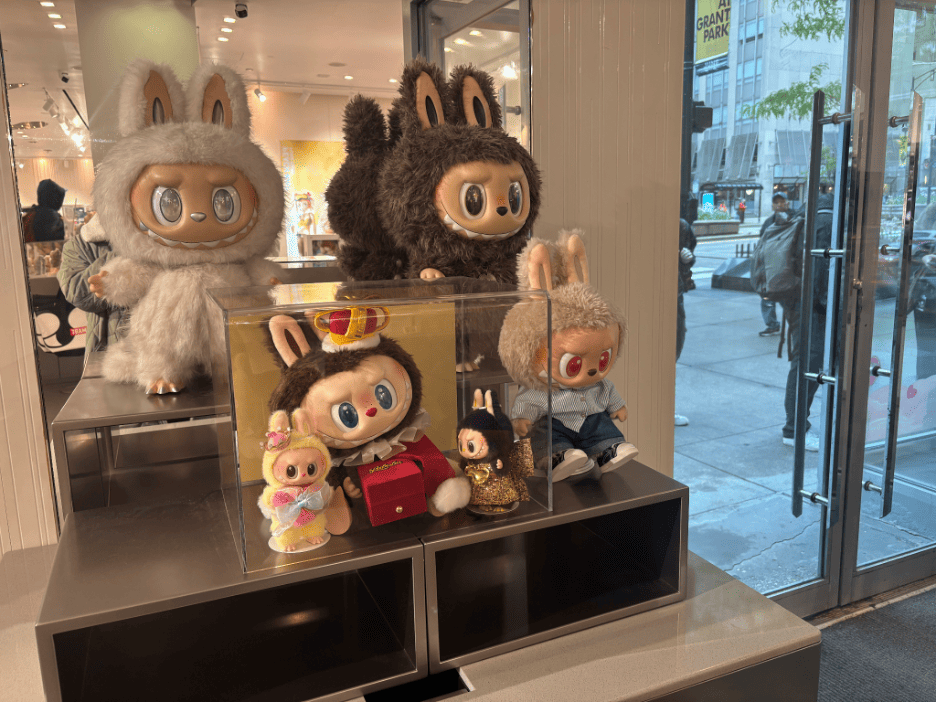
One thing Monica Ruano can’t leave the house without is her Labubu. The fuzzy doll hangs from her bag, with rabbit ears, wide piercing eyes and a smile that stretches across its plastic face and shows off its serrated teeth.
“I wear them wherever I go — restaurants, family parties, anywhere people will see it,” Ruano said.
The vinyl collectible toy, made and sold by Chinese toy company Pop Mart since 2019, has become a coveted commodity that has taken social media and Chicago by storm.
Since opening its first Midwestern location last October in downtown Chicago at the Shops at North Bridge on Michigan Avenue, Pop Mart has opened three more stores in suburban Schaumburg, Oak Brook and Rosemont.
A Facebook group started last October dedicated to collecting, selling and trading Labubu toys in the Chicago area has more than 1,700 members as of July 2025.
Ruano said people’s reactions to her companion go one of two ways.
“It’s hit or miss,” she said. “‘Yes, I love it, so cute, where can I get one?’ or ‘That thing is scary looking. Why are you carrying it?’”
The elf-like character first appeared in 2015 in “The Monsters,” a Nordic-mythology-inspired story series by Hong Kong artist and author Kasing Lung.
Labubus soared in popularity in 2024 when K-Pop idols and BLACKPINK’s Lisa and Rosé posted on social media with the toy. Lisa further revealed her “obsession” with Pop Mart in a video with Vanity Fair. Since then, other celebrities have been spotted toting the doll on their handbags. Pop singer and rapper Lizzo even referenced the toy on her song “YITTY ON YO TITTYS,” rapping “How you talkin’ sh** about me? Can’t even outdress my Labubu.”
London-based cultural strategist Nina Maria said the uniqueness of the toy combined with social media has made it a viral phenomenon.
“I think this is such an ugly, cute thing,” Maria said. “And because this looks so individual and weird on a bag, that’s why it got popular in the first place.”
As of July 2025, the hashtag #labubu had more than 2.1 million posts on TikTok.
“If everybody has it, then everybody wants it,” Maria said. “If it wasn’t popular on social media, I don’t think I would have ever bought one, to be completely honest.”
Ruano, 38, said as a millennial, Labubus are also nostalgic.
“I lived through the trend of Furbies and Beanie Babies,” she said. “So now I’m an adult with adult money, so I don’t have to ask anyone (to buy it). There’s no limitations.”
According to Pop Mart’s 2024 annual report, revenue from regions outside of mainland China nearly quintupled compared with 2023, with most of the growth coming from Southeast Asia and North America. The company’s licensed products, like “The Monsters,” made up more than 97% of its revenue for 2024.
Shares of Pop Mart have been on a tear, more than doubling year-to-date. The stock closed at 253 Hong Kong Dollar (HKD) or $32.23, on July 6 on the Hong Kong Stock Exchange.
This exponential growth has spurred the company’s ambitions to double its U.S. locations by the end of the year, according to retail news outlet Chain Store Age.
The Midwestern market is one of the company’s key expansion targets, according to Chain Store Age.
Even the Trump administration’s tariffs are seeming to have little impact on the toy’s popularity. A $6 price increase to $27.99 for the “Big Into Energy” series released at the end of April didn’t deter dozens of people, like Ruano, from lining up outside the store in downtown Chicago to get their hands on the toy.
“I had been there for eight, eight and a half hours, trying to get my boxes for myself and my family,” she said.
Labubus and Pop Mart’s other products also come in “blind boxes,” which means consumers don’t know which toy they’re going to get until they open it. Maria said the surprise element makes these products addictive for collectors and fans.
“There’s a psychological element of the blind box,” she said.
Even without a guarantee of getting the model they want, consumers are willing to wait and pay well above retail value. Ruano started a business reselling authentic Labubus after being laid off from her job in March. She said she sold a single doll for $120 on the platform Whatnot.
“The demand is crazy, and it’s really hard to get your hands on an authentic one,” she said.
Labubus have also spawned a budding market of fake duplicates, dubbed “Lafufus,” which will go for $15-$20. The duplicates will have varying cosmetic differences from the real thing, like the number of teeth or eye color.
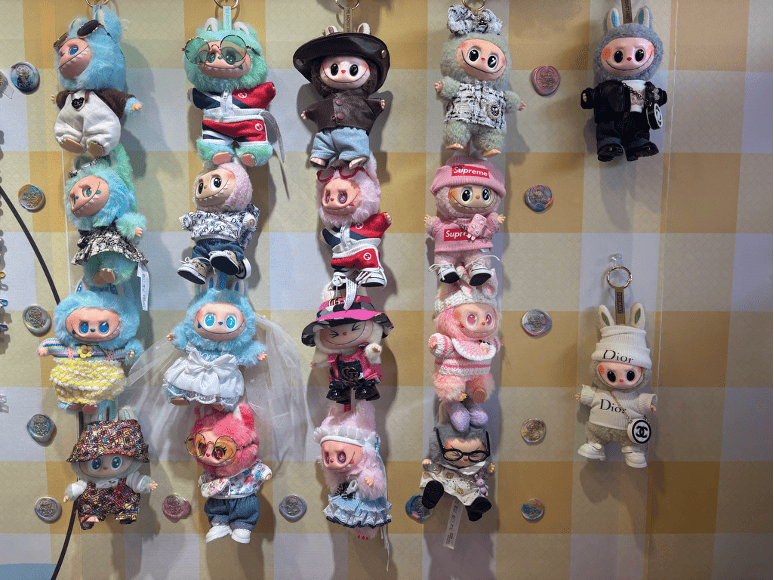
In Chicago’s Chinatown neighborhood, Big Ying Yogurt has become a popular destination for Labubu fans.
The shop opened a year ago to sell homemade yogurt drinks and snacks but has expanded to sell handmade items, like Labubu clothes and accessories.
“Right now, most people don’t even know we sell yogurt,” said Doris Han, Big Ying’s owner.
Diana Gomez, 31, visited Chicago from Los Angeles and came to Big Ying with her friend, Chicago native Jen Arista, 31, after seeing a video about the shop on TikTok.

Gomez persuaded Arista to get her first “Lafufu” after seeing a miniature Chicago Bears shirt for sale at Big Ying.
“I love the Bears, so once I saw this, I said, ‘I need that,’” Arista said. “The clothes are really adorable.”
She completed the ensemble with a pair of brown tortoise shell glasses to match her own.
Gomez got a matching outfit with Arista for her Labubus back home.
“That’s what makes them unique to each person and makes it fun,” Gomez said.
Layna Hong is a graduate student at Medill in the social justice and solutions specialization. Find her on X @laynanhong or Instagram @laynareports.