
By Emma Urdangen
Medill Reports
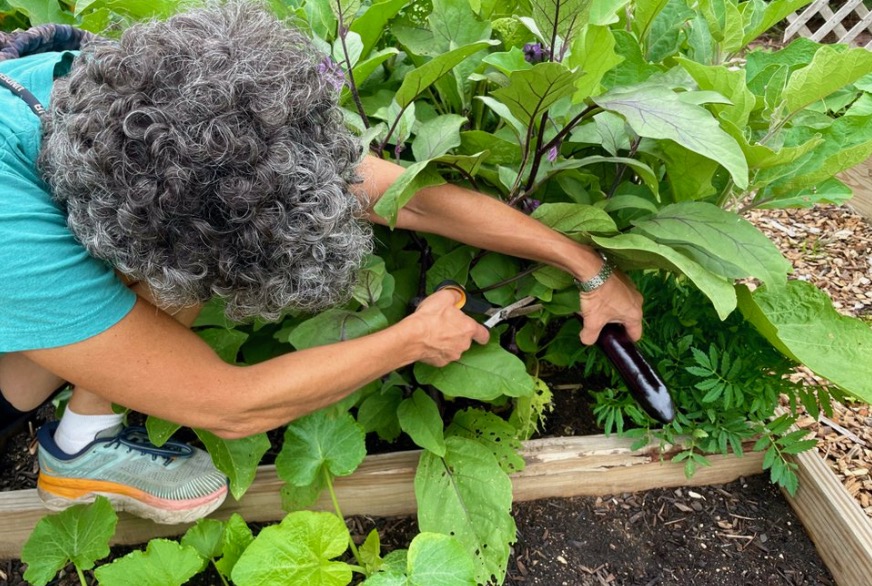
Walking around Evanston, you’ll likely stumble across gardens filled with ripe tomatoes, crisp cucumbers and hearty kale. These patches of vegetables exist thanks to Evanston Grows, a collective impact organization dedicated to increasing access to locally grown produce and reducing food insecurity in the Evanston community.
Reporter Emma Urdangen spoke with Evanston Grows Board President Jean Fies, about the organization’s impact on health equity, sustainability and community-building across Evanston.
Transcript
Urdangen: Hi, Jean, thanks so much for joining me today.
Fies: Hi, Emma, I’m so happy to be here.
Urdangen: My first question for you is, why is it important that this exists in Evanston?
Fies: Evanston is a unique community. It has great wealth and great poverty. It has a very diverse population, ethnically, education status and career paths. It also is one of the largest communities of significant number of nonprofits that actually serve the hometown population. And one area we noticed throughout Evanston that wasn’t being addressed as significantly was food insecurity and health equity. The two sort of go hand in hand, the more food grown locally that’s able to be donated to the community is a great benefit to all. There’s a need, the produce mobile, which has been an ongoing effort that distributes produce monthly in the city of Evanston, that has just been canceled. And a couple other food pantry operations have been shut down and really related to government funding. So now more than ever, people need the produce, and we want to make sure we can grow accordingly.
Urdangen: What does health equity mean to you, and how does Evanston Grows work toward that?
Fies: That’s a great question. The example I like to offer for health equity is a lot of people who have limited access to fresh produce receive produce from food pantries, and the staple of produce for those organizations are usually onions, potatoes — things that have a long shelf life. Those are great items, but they’re not like the kales, the lettuces, even tomatoes, they don’t last quite as long. And health equity to us means saying we are offering everything you can get at the grocery and not worry about the price. For example, if you go to the grocery today and try to buy organic lettuce, you know that that clam shell of lettuce is like $6, $7 or you could get a head of iceberg lettuce that’s maybe a dollar. Well, you’re going to pick the dollar iceberg lettuce. In this instance, we offer an endless variety of fresh produce, and people are just really blown away by the opportunity to sort of shop at our farm stands, select the items they want and benefit from all the nutrients from the produce that is not as available to them at food pantries. We have a dignity model. We do not ask questions when people show up to our farm stand. We believe they are there because they need it. No questions asked. Only one of our sites where we distribute produce, which is the Greater Chicago Food Depository food pantry at Vineyard church, do you have to sign up. So maybe someone doesn’t hit the poverty line, however they want organic produce which they cannot afford in the grocery. That’s health equity flowing through.
Urdangen: Another one of your pillars is sustainability. I’m curious, do you see an intersection between health equity and sustainability in your work?

Fies: Yes, sustainability has lots of meanings for the work we do. We think of sustainability from a climate impact, we think of it from the food insecurity impact, and we think of it from an organizational impact. Directly related to health equity, sustainability is definitely important, because if people are trained to eat this healthier diet, they’re going to live a healthier life. We offer enough produce for them to share with their families. So, from a sustainability standpoint, it’s passing this down to younger generations. Most of the people who come to our farm stand have four or five people in their household. So, by bringing this home, they are again inspiring healthier food practices. The other health equity crossover would be, we work a lot with kids. We do smoothie workshops, we have kids come to the garden, learn how to plant seeds and then maintain and tend the produce as it’s growing and then obviously harvest it, and they eat it, they love it, and they incorporate it into their diets. It’s a way of just inspiring them and growing food at their homes. A lot of them who are in our cohort encourage their parents, “just buy me this stuff and I will grow the plants at home.” And they really talk about how fun it is to taste a tomato that you grow in your backyard versus one at the grocery. They’re almost two different products.
Urdangen: Why do you think it’s important to make this an intergenerational effort, and how do you see this manifest in Evanston Grows?
Fies: Well, I’m a big believer in intergenerational as being critical to us moving ahead as a society in general. I think getting the older generations, who are wise and have a lot of experience growing food, many people that we serve grew up on a farm somewhere. They’ve come from other places, and they have some expertise that we’d love for them to share. And they also love when they come in and they can spend an hour working with a grandchild in the garden. We have this one woman who just loves to bring her granddaughter, and they’ve really bonded, and her granddaughter is now much more interested in growing food. I think we’re such a fast-paced society and our groceries offer everything that we forget these little things of nurturing something, growing it and being able to actually eat it.
Urdangen: In regard to sustainability efforts, the federal government has recently made cuts to climate initiatives, including eliminating extreme weather cost tracking and considering prohibiting states from including pesticide warnings on food labels. Why do you think urban farming and community gardens like Evanston Grows are more important than ever?
Fies: Our produce travels extensively to get to us. And if we grow it locally, and it’s a little piece of the world, but we are reducing those transportation efforts. So much of our produce, if you really read the labels, comes from South America or comes from Central America. It comes from places that need trains and cargo ships and all sorts of different ways to get it to us. We use leg power to pick in a garden and bring it across the street to the farm stand to distribute to people. All of our produce grown is organic. All of our farms have pollinator plants around, which help keep gardens alive. If we’re greener, our air is cleaner. And obviously, we don’t use any big equipment to grow. We have an extensive number of volunteers, we have interns, we have a staff, and you’re using your soil much more effectively. It’s healthy for your soil to be growing things and letting the ecosystem evolve like it should naturally.
Urdangen: If you’re just joining us, you’re listening to Medill Reports, and we’re speaking with Evanston Grows Board President Jean Fies. So, what are some challenges in accomplishing Evanston Grows’ mission?
Fies: Probably our largest obstacle is land. Obviously, Evanston is a thriving community with not a lot of available land. As far as urban farming goes, the greatest developments have happened on sort of blighted and vacant lots, and Evanston does not have a lot of those sites. We’ve been lucky to get land from the city of Evanston, from private corporations and some private residences have offered their backyards where we are doing an experimental farm. We are working with the city of Evanston to identify a one-acre plot of land that was won through a participatory budgeting vote. And if, and when, we do secure this land, we will be able to more than double our current production, and I think that will allow us to make even a much greater impact.
Urdangen: Some warn of trendiness or risks of gentrification in urban or community gardening efforts. How does Evanston Grows make sure to establish trust in the community and avoid harm?
Fies: I love that question because it’s really important to state that Evanston Grows is a collective. When we founded the organization, we reached out to everyone in the food insecurity lane in Evanston and brought them together. And there were about 10 of us that sat in meetings on a weekly basis, and we tried to knock down silos and figure out how we can do this together. We didn’t want to come in and say to someone, “Here’s what we’re doing. You should like what we’re doing.” We were really trying to find out, A, what was going on in the community; B, what was the need; and C, who we could engage within the community to help us build this organization from the ground up. We found out that all these other entities who were doing work that was tangential or similar were really, really, really small, and they were completely volunteer-run. A lot of efforts that are completely volunteer-run go for a couple years, and they sort of fizzle out, which makes sense. People get tired, they move on, things happen. And we felt the only way to really be truly sustainable as far as a long-term organization is to have a paid staff. And so, we did found a 501(c)3. And in the creation of that, a lot of those smaller organizations have sort of folded into us, or certainly we have worked super closely with them to make sure their efforts continue and how we can support them, so that we are not duplicating efforts in the community. And we have recruited an extensive number of volunteers from the community, who live in the neighborhoods, people who live across the street from these plots of land, or who are receiving the produce, are now our volunteers. They tell us what they want grown. They tell us how we can improve our efforts. They tell us what classes we should offer. We offer a lot of educational programming. We’re really listening. We don’t ever want to come in as the expert. We really want to come in as the partner and the organization that is able to engage and excite the community. I heard you use the word gentrification, which is always a fear, certainly, of communities, and it’s a fear for us too. We want to make sure that all we’re doing is adding another component for them to have access to. But we have found that a lot of these communities really appreciate these engagement opportunities.
Urdangen: What are some ways that you make getting involved equitable as well?
Fies: Well, the first point is we have to be asked. So, we have worked closely with the Foster Senior Club, and a lot of them don’t have physical mobility to get out and dig in the dirt with them. We have this amazing woman who has four acres in Winnetka who donates flowers on a weekly basis, and we give away about 125 bouquets a week of — I mean, stunning, nicer-than-the-flower-shop flowers. But the seniors love to come in, and they put the bouquets together. We do a pickle-making workshop with the seniors and a soap-making workshop. Then, for people who are a little bit more mobile, they really wanted to have a planter at their house, something they could put on a patio or even inside. And we’ve done container gardening classes for them to make sure that need is answered. The students that are participants in the city of Evanston camp programs — like, if you’ve ever seen a carrot seed, it is teeny, teeny, tiny. Their attention span isn’t going to focus on that — but they’re certainly super excited to go pick a few leaves of kale and make a smoothie with it. So, we really try to tailor all the opportunities to our audiences and certainly engage their feedback on what would be most appropriate for all the different groups we’re serving.
Urdangen: My last question for you is, where do you hope to see Evanston Grows go in the future?
Fies: I love this question because I do have a dream, and it is that we can create a food hub. It would be a bricks and mortar where we aggregate food, we conduct educational programs, we cook things, we have some sort of commercial kitchen where we make basil pesto with all the basil, we grow our pickles — we grow a lot of cucumbers, which we make into pickles. But we want it to be a community, collaborative opportunity. We’ve started working on this project, and our funding for just feasibility studies and working with consultants got cut. So, we’re sort of in a holding pattern. We hope things change and we can continue this work, because what we’re doing, or the part we were entering into through the feasibility study, was identifying partners who would most greatly benefit from having such a building, such as a food hub. Connections for the Homeless, Kurtz Cafe is another one, Evanston Latinos. I mean, really identifying who has a need to have a commercial kitchen, a food aggregation site. That is a big dream that we want to realize in the next five years or so.
Urdangen: Jean, thank you so much for speaking with me today.
Urdangen: That was Evanston Grows Board President Jean Fies. To learn more, check out Evanstongrows.org or visit one of their gardens around the community. Thanks for joining me. With Medill Reports, I’m Emma Urdangen.
Emma Urdangen is a graduate student at Medill in the magazine specialization with a concentration in podcast journalism. You can find her on LinkedIn at www.linkedin.com/in/emmaurdangen and see the rest of her work at emmaurdangen.com.