
By Brendan Preisman
Medill Reports
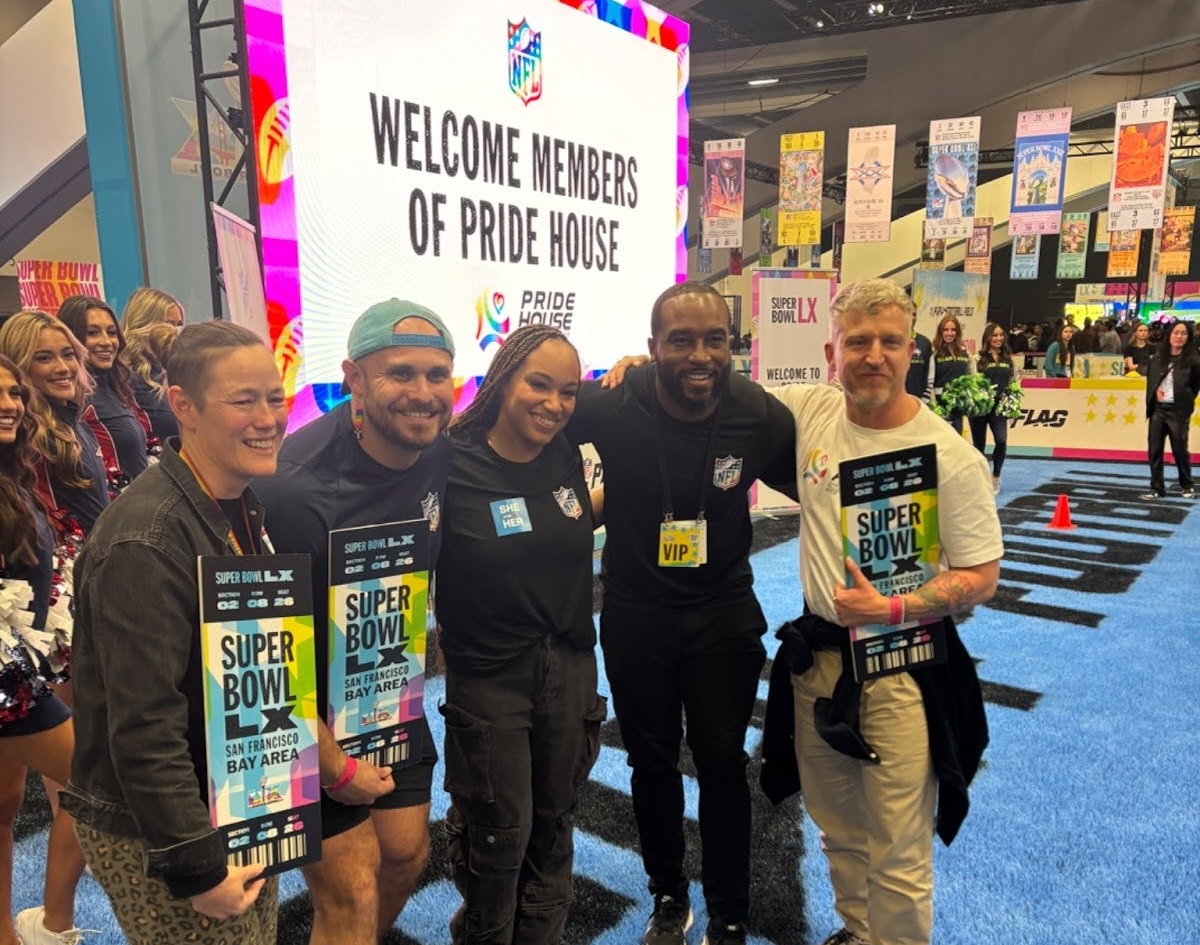
SAN FRANCISCO — Most football players are used to receiving motivational messages ahead of game time, but for the group of players from the San Francisco LGBT Center and Pride House SF, their message was extra special. It came from the very top of the football world — NFL Commissioner Roger Goodell.
“Football is for everyone. Thanks for being a part of it, and for being a part of our Super Bowl,” Goodell said via video message Wednesday evening. “Be proud of who you are, because we’re proud of you.”
The NFL’s messaging could not be clearer: The most powerful sports league in the country is welcoming and appreciating LGBTQ+ participation. Nick Ward, director of programming and partnerships at Pride House SF, said he was impressed with the NFL’s boldness.
“To see such an influential organization be so vocal about inclusion is not only important, it’s surprising in this moment,” Ward said. “They’ve been really intentional about creating this space with us. They’ve been amazing.”
The San Francisco LGBT Center has been creating inclusive spaces like that since its founding in 2002. Rosemary Gardner, the center’s director of community programs, is currently responsible for that creation process. Many of those programs are focused on helping members of the queer community ages 16 to 24 find spaces in which they can be themselves.
She said events like the Pride Flag Football Clinic serve that purpose well.
“I think it’s always been important for queer kids to feel accepted and to be seen and validated,” Gardner said. “It makes sense to ensure that if kids are playing a sport, that they’re really able to show up as themselves.”
Flag football has allowed members of the queer community to show up as themselves in San Francisco for years. While the San Francisco Gay Flag Football League didn’t officially become a league in 2010, it has been operating since 1998.
It serves as a branch of the National Gay Flag Football League, which has collaborated with the NFL for several years. That collaboration was in full force Wednesday night.
“(SFGFFL) board members are here to help these youth and let these youth know that there is a safe place on the field that they can explore their athleticism,” NGFFL member Jon Erickson said. “It’s an incredible opportunity for the local community here. … It’s part of the magic of what we do.”
Trinity Monteiro serves as the NFL’s senior coordinator for social responsibility and seeks to help create that magic through league events. She’s aware the NFL, and football as a whole, have typically been heteronormative spaces, but said opportunities like the Pride Flag Football Clinic are helping to change that stereotype.
“This flag (football) opportunity brings access to all different types of people,” Monteiro said. “We understand the power that we have. We want to reinforce … that this game is for everyone.”
Even after the Super Bowl festivities end and the NFL departs San Francisco, the San Francisco LGBT Center and Pride House SF will continue creating spaces for their communities.
The 2026 FIFA World Cup, hosted by the United States, Canada and Mexico — which will include games in San Francisco — is another key focus for the Pride House’s outreach programs. However, the organization is also fully aware the real work continues after these large-scale events end.
“It’s about consistency. Ensuring that it’s not just a moment for the Super Bowl, it’s consistent whatever the time of year,” Ward said. “What happens next? What do we do when this is all over, to ensure that we’re still supporting folks in the community?”
Spaces that support the queer community have existed for generations in San Francisco. Though things are far from perfect for the city’s LGBTQ+ residents, San Francisco’s long history of being at the forefront of queer acceptance provides the blueprint for the road ahead.
The city boasts, among other achievements, the first openly gay political candidate in the United States (José Sarria, who ran for the San Francisco Board of Supervisors), the first openly gay public official in California (Harvey Milk, also on the San Francisco Board of Supervisors) and the first lesbian bar (Mona’s 440 Cub). Last summer, Rikki’s, the city’s first sports bar to focus entirely on women’s sports, opened in The Castro, a queer neighborhood in central San Francisco.
“We actually were thinking someone else in San Francisco would do this. We kept waiting and waiting, and nobody did,” Rikki’s co-owner Danielle Thoe said. “So eventually we decided: We’ll do it ourselves.”
Thoe’s story is an example of self-reliance, but support and inclusion have started to come from outside the LGBTQ+ community as well, especially from the Bay Area’s professional sports teams. The San Francisco Giants, Golden State Warriors and San Jose Sharks all celebrate annual Pride nights. The San Francisco 49ers, meanwhile, have a fan group called 49ers PRIDE, which hosts seasonal watch parties and drag brunches.
But members of the queer community know there is still a long road to full acceptance.
“I want to see folks not surprised that queer folks are here and they feel part of this community,” Gardner said. “I want it to just be a given that this is a space where queer folks can come and be included. I hope it feels like, ‘Yes, of course they’re doing this. Why would they not do this?’”
Achieving that level of inclusion in the NFL’s space is no small feat. As Thoe notes, the league is widely perceived as skewing heavily cisgender and straight — both in terms of its players and its fan base. Yet the league still chose to host multiple events geared toward the queer community, including a Pride Night gathering.
“To have the league putting their name behind that … I think for them, it’s a small step, but it feels really big, because you don’t see that much reflected on an NFL field,” Thoe said. “It’s a good human decision.”
That “good human decision” might have seemed simple and small, but it didn’t happen overnight. Months and years of support and inclusion — in San Francisco writ large, in the general community of sports fandom and, most recently, directly from the NFL, have helped build to this moment — a welcome and celebration of the queer community by the league.
Having LGBTQ+ youth play flag football in the middle of the league’s weeklong Super Bowl buildup wasn’t an accident, it was an intentional culmination of what the NFL aspires to represent. For Ward, Wednesday night was a time not just for joy, but also for thankfulness.
“Representation is the key to building your confidence and getting to know who you are as a queer person,” Ward said. “The more visibility and representation there is in all areas, that’s how we survive. I’m just so grateful that we could do this together.”
Brendan Preisman is a sports media specialization graduate student at Medill.