
By Monique Louis
Medill Reports
SAN FRANCISCO — One week ago, Bad Bunny was the first Latin artist to win the Grammy for Album of the Year. On Sunday, Bad Bunny was the first solo Latin artist to headline America’s most-anticipated and most-watched production: the Super Bowl halftime show.
Bad Bunny starred in the most anticipated halftime show to date, and was expected to beat Kendrick Lamar’s record-breaking viewership of 134.5 million in Super Bowl LIX. Bad Bunny was crowned the most-streamed artist in the world for a fourth time in 2025 after three-peating from 2020 to 2022.
“Certainly, (this moment) means a lot for Puerto Ricans,” said Albert Laguna, a Yale University professor who has taught a class titled “Bad Bunny: Musical Aesthetics and Politics.”
While Bad Bunny’s large fan base was excited for the six-time Grammy winner’s performance, some conservatives were upset by the selection. Turning Point USA, a right-wing nonprofit founded by the late conservative activist Charlie Kirk, hosted its own musical performance during the Super Bowl halftime show.
“I’m anticipating (Bad Bunny) is going to set the tone with a very powerful message, especially with some of the backlash people tried to give the NFL for choosing him,” Super Bowl Week attendee Dylan Urbaez said Friday.
Urbaez, who has Puerto Rican roots but was born and raised in Los Angeles, summarized the fears of many critics: “He’s already shown us that he’s going to do everything in his power to use his platform to shed light (on Puerto Rico).”
Bad Bunny, whose real name is Benito Antonio Martínez Ocasio, has been vocal about the struggles facing Puerto Rico since Hurricane Maria, which rattled the island in 2017. One of those struggles, in a paradoxical manner, is immigration.
Puerto Rico is a U.S. colony, so its inhabitants are American citizens. Still, “the history of Puerto Rico has been marked by immigration,” Laguna said. “You can’t tell the history of Puerto Rico without migration. Part of Bad Bunny’s vision is a Puerto Rico for Puerto Ricans, where people can have success on the island and not have to leave.”
Migration from the island to the mainland boomed in 1945. There are now just fewer than 6 million Puerto Ricans living in the continental U.S., the second-largest Hispanic ethnic group in the States, according to research published in EBSCO.
Despite their U.S. citizenship, there have been multiple incidents of Puerto Ricans being harassed or even detained by Immigration and Customs Enforcement, according to the Human Rights Research Center.
Bad Bunny has been vocal in denouncing the Trump administration’s ICE raids and decided against touring in the U.S. out of fear the agency would detain concert goers at his performances.
After his second Grammy win Feb. 1, the performer said “ICE out” and urged people to fight hate with love.
“We are not aliens,” he said. “We are Americans.”
Scholars say this rhetoric reflects competing ideas about what it means to be American. Bad Bunny, who is undeniably American, still knowingly and proudly represents immigrants from all over Latin America.
“He knows that this is an experience that a lot of people from Latin America and their kids have had in the United States,” Laguna said.
But “Trump and his supporters have a particular vision of the United States that is not compatible with the vision of Americanness that Bad Bunny is offering: plurality (and) diversity,” Laguna continued.
Because of who Bad Bunny represents, Laguna posits the performance — which was imbued with cultural imagery and concluded with a pronounced message about unity — was inherently a “powerful foil to the anti-immigrant rhetoric and the violence we’re seeing in our streets across the country.”
Despite the backlash, the halftime show was widely regarded as a celebration. For many Puerto Ricans, particularly those in the Bay Area, seeing their culture celebrated matters more than any political statement the artist might make.
Puerto Rican restaurant Parada 22 owner Philip Bellber said he is grateful for the “focus that (Bad Bunny) has brought to the culture,” and explained the restaurant has benefitted from the announcement the Puerto Rican artist would headline the halftime show, with increased foot traffic and even an appearance on KTVU Fox 2 local news.
When asked about his hopes the artist would use his platform to speak on political matters, the restaurant owner said, “he’s already made statements … he doesn’t really need to say anything else. Everybody knows how he feels.”
Bellber said it was more meaningful a Puerto Rican was representing the island on America’s largest stage.
“All the publicity that he’s generated for Puerto Rico, I think it’s fabulous,” Bellber said.
Content creator Jorge Roque-Rivera, known online as FreaknRican, said Monday he was “wildly excited” for Bad Bunny’s halftime performance, although he hoped the artist wouldn’t make a bold political statement. “But I do want him to represent Puerto Rico as hard as he can,” said Roque-Rivera, who was born on the island and raised in York, Pa.
Amid the controversy, Bad Bunny says his show is about unity, love and, most of all, dancing.
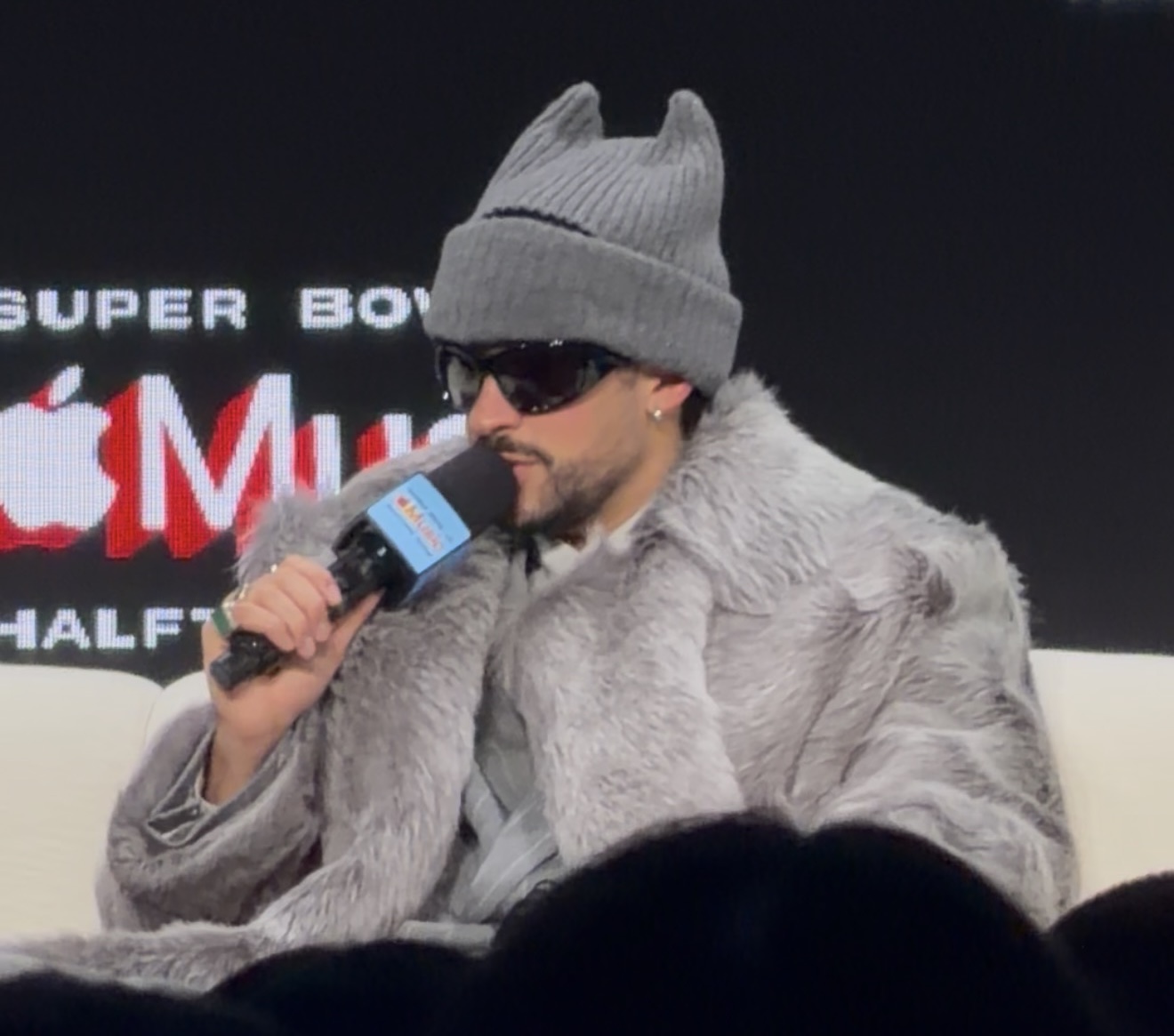
“I just want people to have fun … it’s going to be a huge party,” the superstar said at the halftime show news conference Thursday.
Ultimately, the NFL chose Bad Bunny because of his global influence. In an interview published Feb. 1 with The Athletic, Jon Barker, NFL senior vice president and global head of major events, said, “Between (the NFL), Roc Nation and eventually who that artist is, we’re all unified in that mission, which is to deliver a global entertainment moment that really unifies the world around this sport and this game and that particular moment in time.”
“He’s the most popular artist in the world,” Roque-Rivera said, “and the NFL is trying to target the whole world.”
NFL Commissioner Roger Goodell corroborated this statement at the annual state of the league address Feb. 2, telling reporters, “Bad Bunny is, and I think that was demonstrated (at the Grammys), one of the great artists in the world, and that’s one of the reasons we chose him.”
The NFL has hosted a record seven games on foreign soil and will add two more international games to its 2026 schedule, including debuts in Melbourne, Australia, and Paris.
At the halftime show news conference, the Latin artist said, “What I want to bring to the stage, of course, is my culture … and I know that I told (everyone) that they had four months to learn Spanish. But they don’t even have to learn Spanish! It’s better if they learn to dance.”
Bad Bunny’s show is inherently political. Not because of the artist’s outspoken nature, but because his identity is a hot political topic.
“Bad Bunny is going to have a moment,” Laguna said. “He earned it through his popularity and how big he is. And I hope he does something with it.”
Monique Louis is a sports media specialization graduate student at Medill.