
By Justin Parmer
Medill Reports
SAN FRANCISCO — Bay Area Rapid Transit is rapidly approaching the proverbial financial cliff. According to the latest BART funding overview, the regional transit network centralized in Oakland and San Francisco is facing a $376 million budget deficit that would require drastic measures to resolve without additional state funding.
Should voters fail to pass Senate Bill 63 in the November elections, BART says it would be forced into a systemwide service reduction plan beginning in January. The cuts would include the closure of 10 of BART’s 50 stations, a 25% reduction in train frequency, the elimination of late-night and early-morning service on several lines and the potential layoff of more than 1,000 employees.
“I think it’s ridiculous,” said Malik Johnson, who uses the South San Francisco station that is among the 10 potential closures. “Look at all the people getting off here. Now those people (would) have to go somewhere else to go to work or school.”
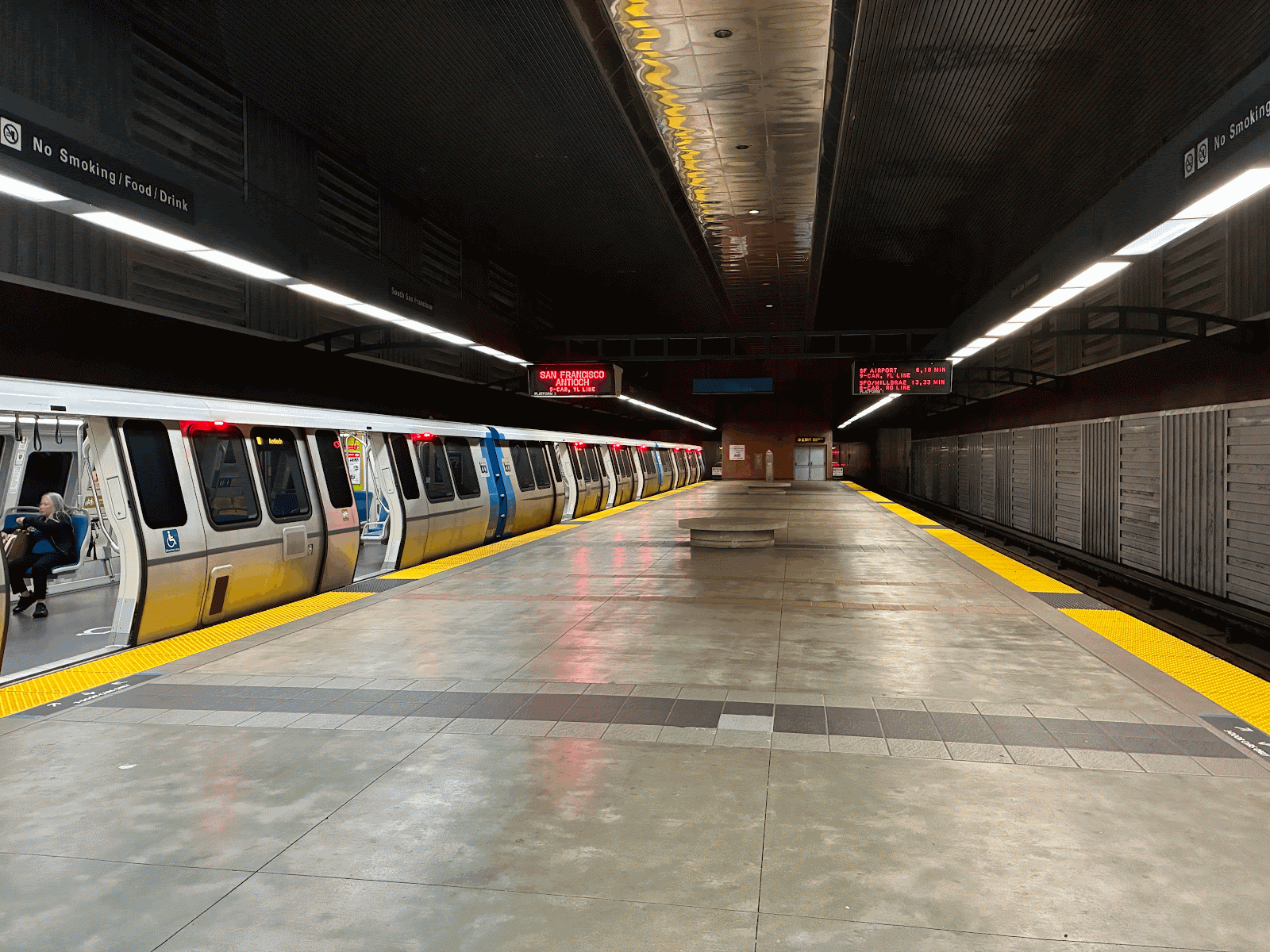
Of the 10 stations that could see service suspended, six were built at the beginning of the millennium. That includes the South San Francisco station on the Red and Yellow lines that was opened in 2003 and serves an average of 1,538 passengers on weekdays, according to a January BART ridership report.
“I’m not surprised, but I’m hopeful that that’s not the case,” said Jessica Stanfill, a rider at the South San Francisco station. “I think here in South City, it’s an important link and we need as much help as possible. I know we have a bunch of people that work in the city.”
Even an initial round of cuts might not be enough to solve the budget crisis. Should BART determine the Phase 1 cutbacks are inadequate, the transit network could make additional cutbacks in services as soon as July 2027, including the suspension of the Blue Line, which provides service to Castro Valley and Dublin.
The cuts would also suspend service from North Concord/Martinez through Antioch on the Yellow Line, reduce hours on the Red Line and curtail the length of the Orange Line from reaching San Jose.
“If you built your life, you moved out there because you couldn’t necessarily afford to live in downtown San Francisco or the East Bay, but you bought close to a BART stop,” said Jacob Wasserman, a researcher at UCLA’s Institute of Transportation Studies. “Now it might lead people to change jobs. It might lead people to change where they live, and certainly is going to change how people get around.”
Like Philadelphia’s Southeastern Pennsylvania Transportation Authority network and Chicago’s Regional Transportation Authority, the reason for the financial cliff comes as emergency funding from the pandemic begins to run dry. While Bay Area transportation received roughly $4.5 billion through three separate COVID-19 relief packages, according to the Senate Committee on Revenue and Taxation’s 2025-26 hearing in April, the efforts haven’t been enough to stave off the budget cliff. With the federal government less focused on public transportation, it’s largely up to the state to allocate resources to public transit alongside ridership – one that’s fallen in recent years.
“Pre-pandemic, they were actually doing really well in terms of ridership and the consequence finances, because they were so dependent on fare revenue,” Wasserman said. “Since the pandemic, that’s all turned on its head. Downtown trips are not recovering the way that leisure and non‑commute trips have.”
While BART reported a weekday average ridership of 172,173 people in its December 2025 report, it is a far cry from the 376,552 weekday riders the system carried in December 2019. The 54.3% reduction in ridership has caused a significant strain on BART in particular, due to the agency’s heavy reliance on fare revenue to fund daily operations.
This has left the network vulnerable to long-term shifts in commuting patterns following the COVID-19 pandemic, like virtual work. As more companies shift to remote work and retailers scale back their physical footprints, Bay Area residents are traveling less frequently to downtown Oakland and San Francisco.
“Pre-COVID, my husband and I used to commute every single day downtown to work in tech,” Sharon Yep said while traveling with family to Super Bowl festivities earlier this month. “Now we maybe take it four or five times a year, round trip.”
Yet even if BART is able to convince voters to pass the measure this November, the agency would not be fully in the clear. While voters have historically supported public transit in the Bay Area, experts like Wasserman caution the funding alone won’t resolve BART’s long-term challenges.
“BART’s in a weird position where they have to both message about the downsides of the cuts … but also talk about (how they) can manage this money competently.” Wasserman said.
Wasserman also warns station closures could cause the transit network to enter a cycle in which reduced service drives away riders, further shrinking revenue and triggering a deeper crisis.
For individual riders such as Jessica Stangill, the stakes feel far more personal. If the bills don’t pass and station closures follow, many commuters will have to find new ways to get downtown, which could come at a cost both financially and otherwise.
“We’ll still use it,” Stangill said. “We’ll just try to figure out a way to make it work.”
Justin Parmer is a sports media specialization graduate student at Medill.