
By Bianca Javate
Medill Reports
When E.l.f. Beauty announced May 29 it would acquire Hailey Bieber’s skin care line Rhode for $1 billion, its stock surged 24% in just a few days. This is an unusually sharp move as, based on historical market data compiled by Financial Samurai and DataTrek Research, the S&P 500 typically shifts less than 1% on most trading days.
“The valuation of $1 billion for such a young brand is kind of unheard of,” said Kelly Kovack, founder and chief executive officer of industry publication BeautyMatter. “I think strategically, I mean, E.l.f. made a statement, like ‘we’re here, we’re a massive acquirer.’ . . . I still think it’s a pretty risky deal, but if it succeeds, it’s a huge win.”
E.l.f. Beauty Chief Financial Officer Mandy Fields struck a more optimistic tone during the company’s first earnings call after the Rhode acquisition, as reported by Vogue Business in August. “We’re pleased with what we’re seeing out of Rhode,” Fields said. “We’re so excited about all the signals that we’re seeing.”
Once dismissed as vanity projects, celebrity beauty brands have evolved into billion-dollar assets. Rihanna’s Fenty Beauty and Selena Gomez’s Rare Beauty are prime examples of when star power meets product credibility.
Rare Beauty, launched by Gomez in September 2020, was reported by Bloomberg in 2024 to be exploring a valuation near $2 billion. Meanwhile, Rihanna’s Fenty Beauty, which was launched in 2017 and developed alongside LVMH Moët Hennessy Louis Vuitton SE, was estimated by Forbes to have surpassed a $2.8 billion valuation in 2021.
“There was a huge boom in the celebrity beauty world between 2017 to 2022. . . . After Fenty Beauty, people really started to understand how much money could be made,” said Emma Sandler, former beauty editor at Glossy.
But Fenty’s and Rare Beauty’s success does not overshadow the cautionary tales presented by other brands.
Kylie Cosmetics skyrocketed, then collapsed. Lady Gaga’s early Haus Labs launch fizzled. JLo Beauty barely registered.
“There have been a lot of brands from celebrities. Many have failed, some have succeeded and some are just hanging on,” said David Swartz, senior equity analyst for consumer research at Morningstar.
Analysts, including Swartz, point specifically to Kylie Cosmetics, which Coty Inc. bought a majority stake in for $600 million in 2020, as one of the more unfortunate cases. The deal was widely criticized as overvalued, and Coty Inc.’s SEC filings later reflected steep sales declines.
“Sales may be strong to begin with, then fall off significantly. Kylie’s sales exploded, then fell like a rock,” Swartz said.
“Celebrities are very good for awareness and trial, but they don’t guarantee repeat purchase,” said Jeff Lindquist, managing director and partner at Boston Consulting Group with a focus on consumer practice. “What really matters is product durability.”
Sandler doubled down on this statement.
“Consumers are inherently cynical. When they see something inauthentic, they’re quick to denounce a brand,” she said.
Lindquist recently published a report on Gen Z consumers, titled “The New Face of Beauty: Inside the Teen Mindset,” which looked into the spending habits of this demographic. His findings highlighted how critical authenticity is when deciding to make a purchase and how it became somewhat of a make-or-break factor.
“Gen Z, actually, I think, is the generation that’s really also picking up on that and being skeptical about what they’re being sold,” he said. “They’re realizing that all of these people that are fun to watch on whatever, they’re actually trying to sell me something.”
Rhode, backed by Bieber’s “clean girl” aesthetic, already has strong Gen Z traction. Its patented phone case, which contains a holder for its peptide lip tints, went viral upon its release in February 2024. Its virality resulted in a waitlist between “200,000 and 400,000 people,” as reported by Vogue in April 2024, and prompted a restock less than two months later.
Public figures, including influencer Alexandra Saint Mleux, two-time Olympic gold medalist Sunisa Lee and pop star Tate McRae, were spotted with the cases. Saint Mleux and McRae, who both have a large Gen Z following, even fronted campaigns for the brand – solidifying its reach among the younger consumers.
Madhav Pitaliya, an analyst at Coresight Research who tracks global consumer companies, noted how success in this category comes through a combination of product performance, celebrity image and staying true to what the product claims to be.
“Rare Beauty, for example, (Gomez) presented the products as vegan and cruelty-free, and whatever we are seeing now is whatever she promised,” he said. “She achieved that trust through selling the products to the consumers. . . . Rare Beauty and Rhode are very great examples of how the success of celebrity-led brands is driven by influencing people and providing a better product.”
Looking at the partnership between E.l.f. Beauty and Rhode, Pitaliya described it as a “synergistic effect” where “E.l.f. expands Rhode’s reach, and Rhode brings Gen Z-focused products.”
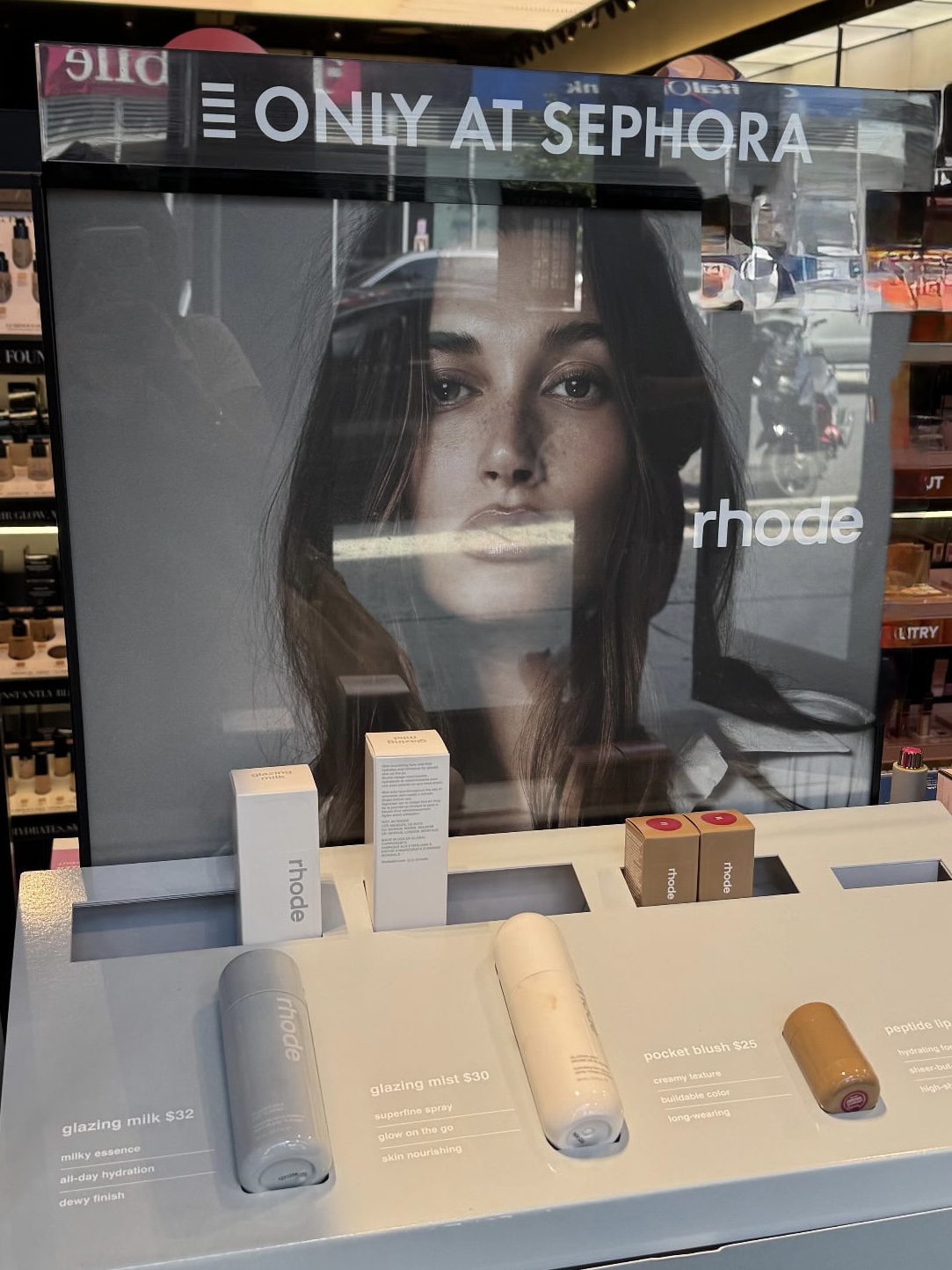
Leah Fey, a business consulting research associate and E.l.f. Beauty consumer, said she’s eager to see the partnership “flourish” as it will bring Rhode into the wider market, including physical retailers such as Sephora in September.
“It’ll be so much easier to test it out in person,” she said. “But for me, it’s not just about the product. It’s about the mission and the values behind it. If a celebrity really stands for something, that matters.”
On the other hand, Kat Smit, a systems engineer who frequently purchases from E.l.f. Beauty, doesn’t share the same enthusiasm as Fey.
“Celebrity ties don’t influence me at all,” she said. “I buy based on quality and price. That’s why I love E.l.f., because it’s affordable and (it) works. Rhode feels more prestige than budget, but maybe this acquisition will help E.l.f. expand its reach.”
E.l.f. is known for its affordability (averaging $6.50 per product), whereas Rhode’s product prices range from $20 to $135. Rhode’s higher-end positioning complements E.l.f. Beauty’s mass-market appeal, slotting both into the growing “masstige” category, which includes products priced between drugstore and prestige.
Research projections from Trilogy Laboratories estimated the U.S. skincare market will reach approximately $23.85 billion in 2024, growing from $22.90 billion the previous year. Masstige products continue to fuel much of that growth.
“The masstige middle has seen a tremendous amount of growth in skin care, in body care, in color cosmetics, in hair care. It’s really been where a lot of the growth of like ‘challenger brands’ has come in is playing in that middle . . . offering higher quality at a more accessible price,” Lindquist said.
Social media has accelerated that trend. Dermatologists, influencers and so-called skin-tellectuals on TikTok drive experimentation and longer routines.
TikTok videos tagged #RhodeSkin have attracted millions of views, with users posting “get ready with me” routines that prominently feature Bieber’s peptide lip treatment and cleansers. Lindquist said he believes social media drives value through allowing brands to be discovered and providing research for consumers, a dynamic that explains why brands like Rhode can scale so quickly.
“There has been a sheer amount of innovation in the (beauty and skin care) space across categories,” Lindquist said. “Products that are innovative, things that are blending categories and then, frankly, ones that are just viral because of the amount of celebrity force behind them, that are just causing folks to be obsessed with the newness and trying to consistently buy and add new products and steps to their routines.”
But behind the buzz, the industry faces pressure from rising costs and tariffs, and E.l.f. Beauty is not spared from that.
In its most recent SEC filing, the company reported $980.9 million in sales for the nine months ended Dec. 31, 2024, with net sales increasing by $278.1 million. It also listed 82 employees in China in its 2023 annual report, underscoring its dependence on overseas production.
“Tariffs definitely had a huge impact on beauty products,” Pitaliya said. “The companies that have huge dependency on countries in the APAC (Asia-Pacific) region for raw products are, I would say, in a bad shape due to tariffs. While overall the picture still remains solid, (they) have either shifted to local manufacturing or reduced their intake from the countries where they used to import the products.”
Yale’s Budget Lab has stated the weighted average U.S. tariff rate on consumer goods rose from 2.4% in January to a 28% peak in April, before easing to 16.6% effective in August.
To offset costs, E.l.f. Beauty raised prices by $1 across its product line in August. This was just the third increase in its 21-year history, according to Harrison Brooks of AInvest.
“It’s an industry with strong pricing power,” Swartz said. “Tariffs may lead to some product cuts, but not collapse the category.”
That said, Kovack sees the Rhode deal as a double-edged sword in this climate.
“I think what you get with celebrity and influencer brands is a head start. You have an audience that ostensibly can convert to sales. You get all the buzz, it’s new,” she said. “Where it gets difficult is now you’ve got to build a business under that launch. I think at that stage, the playing field gets a little more evened out because now you’re competing against bigger brands with bigger budgets.”
Kovack added deals involving celebrity and influencer brand tie-ins should be structured in a way that keeps them engaged because “all of a sudden they’re on to the next project,” posing a potential risk in terms of focus. In Rhode’s case, E.l.f. Beauty’s acquisition brought in Bieber as a strategic advisor for E.l.f. alongside the financial aspects of the deal, which include “$600 million in cash, $200 million in shares and a potential $200 million earnout based on the brand’s growth over the next three years,” as reported by the Business of Fashion in May.
For consumers like Fey, the excitement is about access, whereas for those like Smit, it’s about value. As for investors? Lindquist said it’s about whether the hype translates into repeat business.
Vogue Business reported in the same post-acquisition August article that “Elf Beauty’s net sales were up 9 percent year-on-year to $353.7 million in the first quarter of fiscal 2026,” showing a positive outlook for the partnership.
Rhode may prove to be E.l.f. Beauty’s biggest growth engine yet, should its upward trajectory continue – but as seen with other celebrity-tied companies, it could also be a reminder that in this industry, star power shines brightest in the beginning.
“On the acquisition side, I’m kind of mixed on where that will go because there have been some success stories, but there have (also) been acquisitions that end up being big losses for companies because of the link to celebrities,” Lindquist said. “I think acquirers will continue to be skeptical, but what they’re going to look for is if there is a key person or persons involved in the brand that are authentic and are playing in the space that is true to who they are, backed by products that are actually really good and products that people can get behind. . . . But I don’t think we’ll see a tsunami of deals. I think people are being a lot more cautious.”
Bianca Javate recently graduated from Northwestern’s Medill School of Journalism, with a specialization in sports media and a concentration in business. You can follow her on Instagram @biancajavate and see the rest of her work on biancajavate.com.