
By Sydney Meyer
Medill Reports
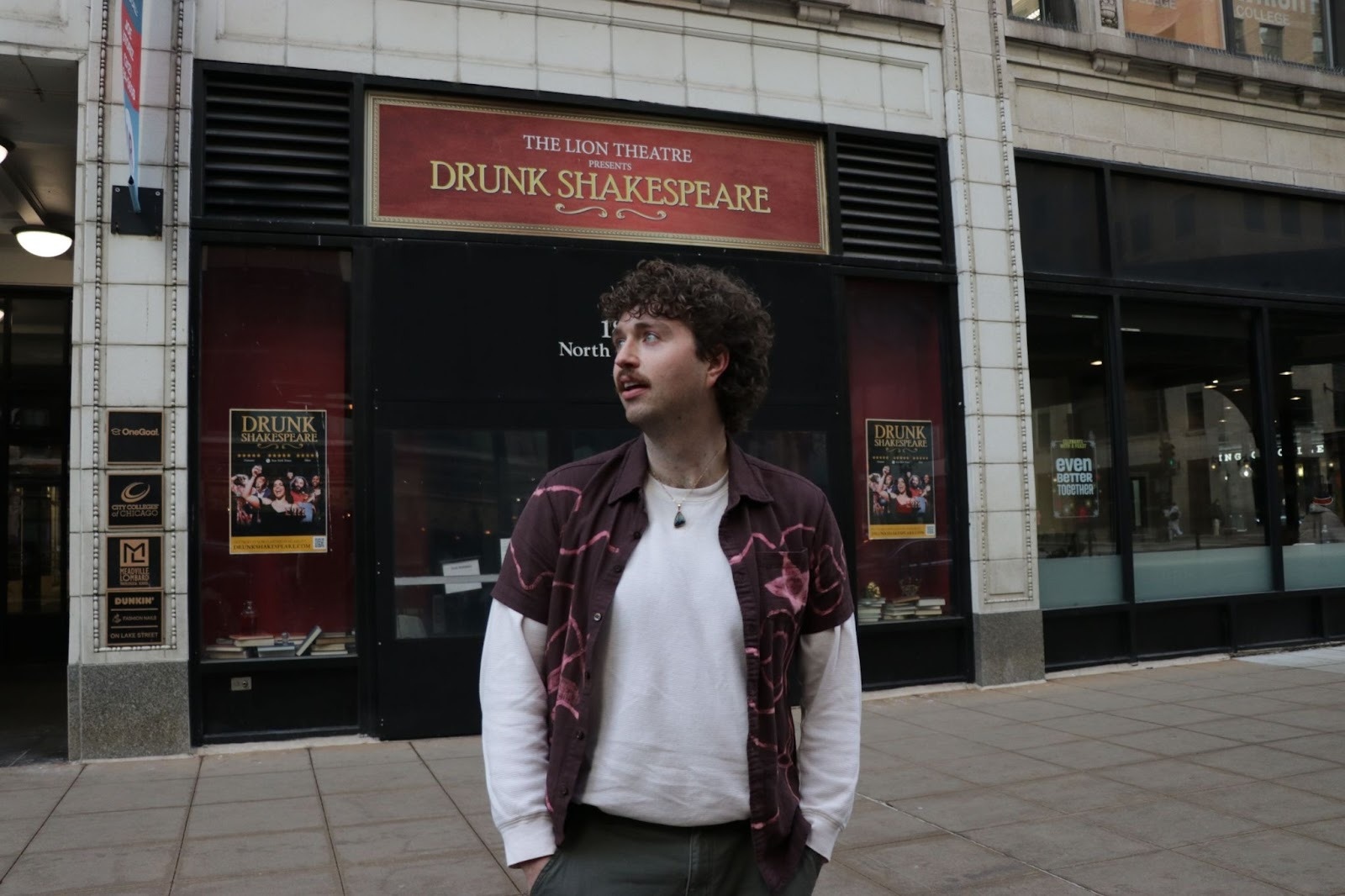
Beginning in October 2024, Caleb Harbin regularly stood onstage in front of an eager audience, downed four shots of a liquor of his choice, and performed the classical titan “MacBeth.”
Between “doths” and “thous,” Harbin created a Shakespearian playground for four other actors, who perform the show sober, through an abundance of improv and two additional drinking challenges. By the end of the show, he would have downed at least two more shots and two more alcoholic beverages. That’s eight standard drinks in a 90-minute period.
Welcome to “Drunk Shakespeare,” Harbin’s first professional theater gig after graduating from DePaul University with a master of fine arts in acting in 2024. His residency with the show came to a close in February after having devoted himself to “getting messed up” about once a week for a year.
Despite the name, “Drunk Shakespeare” isn’t an inebriated free-for-all. The show is performed 10 times over six days each week. That’s a lot of alcohol to pour, so house management commits to scheduling actors for drunk shows only one day of a given week. When scheduled, actors are Breathalyzed after each curtain by house management to ensure they’re below the legal limit. The drunk actor can choose to take a free Uber home after the show or to be signed out by a fellow actor who agrees to be responsible for them that night.
With alcohol embedded into the show’s culture, partying is a ritual among the cast members. Harbin, now 26, acknowledged he drinks much more now with his castmates than he did before joining the show. He described a prompt lifestyle shift: “The first month I was out ’til 5 a.m. four times in a week, and I had never been out ’til 5 before,” Harbin said.
Cast members prepare their bodies for drunk shows like athletes on game day. In addition to physical and vocal acting warm-ups, Harbin learned best practices to manage getting sloshed (stay away from protein shakes, they “nuke” or eliminate the buzz), and how to mitigate hangovers (Morning Recovery drinks from 7-Eleven).
“You do become a professional,” Harbin said.
Ultimately, Harbin said he believes his embrace of partying more accurately reflects how his confidence has grown. After discovering acting in high school, he initially struggled to accept that he wanted to be an artist. Harbin felt pressure from his family to pursue a job with more stability, and felt out of place at his undergraduate institution, Azusa Pacific University, a private, evangelical Christian school 45 minutes outside of Los Angeles.
At Azusa Pacific, students attended chapel three times a week and church on Sundays. Unmarried students were punished if they were caught having sex, queerness and abortion were broadly unaccepted, and alcohol – and its consumption – were banned from campus and all university events, according to Harbin and the Azusa Pacific University Student Handbook.
Harbin struggled with anxiety at the time, “I never really fit in there,” he said. “I don’t think that environment was very good for me or my mental health.”
But, it was an on-campus sermon about Jesus walking on water that gave Harbin the courage to follow his calling. “Jesus said, ‘You have little faith. Why did you doubt?’ And I was like, ‘That’s me,’” Harbin recalled. “I want to be acting and take that leap of faith, and I’m doubting.” The epiphany inspired him to switch his major from education to acting shortly after.
While he acknowledges the irony in his journey from dry campus to professional drinker, Harbin bristles at this framing. Religion no longer plays a significant role in his life, but he did not end up in a job centered around drunkenness to rebel against evangelical Christianity.
“I don’t feel like ‘Drunk Shakes’ is this Rumspringa for me, like the Christian boy is finally out,” Harbin said, referring to the period Amish youths’ leave their community for an often-rowdy excursion into the modern world. “It doesn’t feel like a big deal that I’m drinking. What feels like a big deal is that we get to do a show where there’s so much freedom.”
Despite “Drunk Shakespeare’s” silly premise, Harbin takes it seriously. He credits acting with helping him come into his own and pays back the favor in professionalism.
“I had a massive jump in my confidence and my ability to interact with the world socially,” he said. “Acting gave me a big gift.”
Harbin’s story passes through some of humanity’s most ancient traditions: religion, theater and, yes, alcohol. In that sense, pairing shots with classical text resonates and is treated as sacred.
“The actors take (the drunk show) really seriously because you get to be so free on stage,” Harbin said. “That’s the thing I think is radical about this show. Not the fact that there’s alcohol, but what they’re doing with it.”
Harbin’s journey from anxious teenager to confident adult has been fully realized through ‘Drunk Shakespeare.’ While the show will continue its residency at the Lion Theatre through 2026 (the company recently debuted a new drunk version of ‘Romeo and Juliet’), Harbin is moving on. He’s drinking less and tackling bigger roles. His first job in a feature film began shooting in March, but the lessons he gathered from his time at The Lion Theatre will linger longer than any hangover.
Sydney Meyer is a magazine specialization graduate student at Medill.