
By Naisha Roy
Medill Reports
SALINAS, PUERTO RICO — In Puerto Rico, the symbols are everywhere.
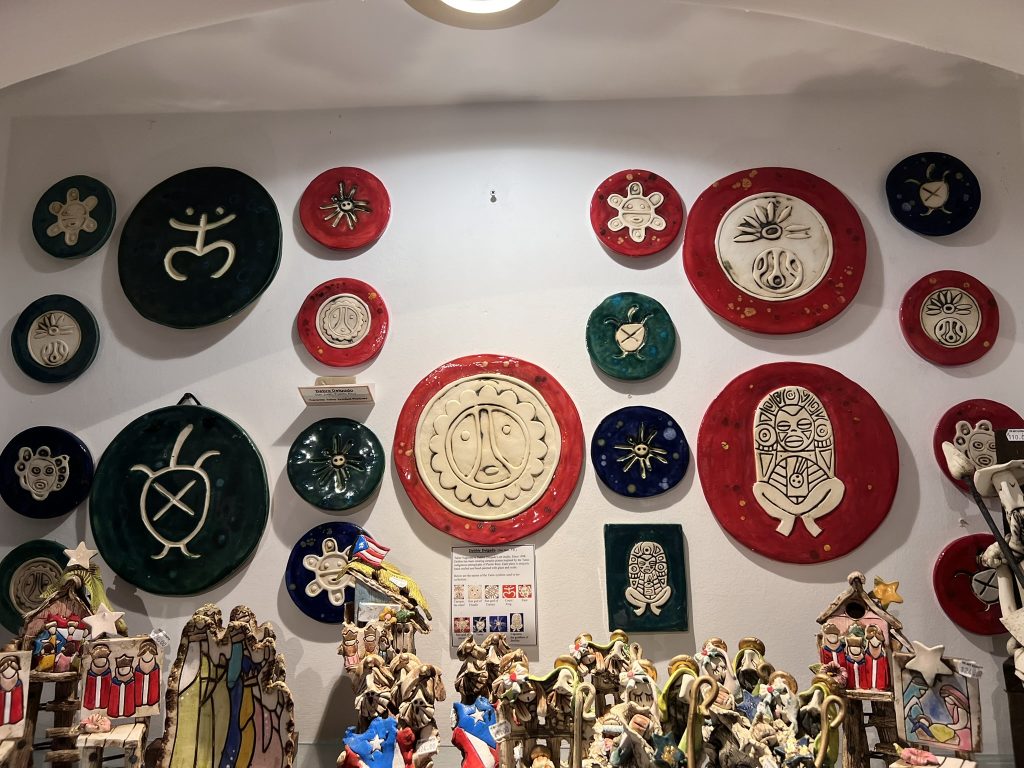
Spirals and almost-cubist faces representing the sun, the coquí frog and other pieces of nature native to the island. They are preserved in rocks breaking up a cascading waterfall in the central town of Jayuya, etched on handmade magnets in Old San Juan and graffitied onto bridges in Salinas on the southern coast. They have made their way across the ocean to Chicago’s Humboldt Park, peeking through the neighborhood’s dozens of colorful murals.
These symbols are Taíno — the most common name for the archipelago’s Indigenous population. While much academic literature treats them like a long-lost piece of Puerto Rico’s past, recent scientific, cultural and archeological discoveries have led to a recent resurgence in Puerto Ricans identifying as Taíno and practicing their ancestral culture.
“Taínos continue to be present in Puerto Rico, even though there have been a lot of changes,” says José López, professor of Latino Studies at University of Illinois Chicago. “In our language, in our food, in our art — everything that’s Puerto Rican — you will find incredible elements of the Taíno people.”
The Taíno motifs are one example. Their origins are petroglyphs, drawings carved into rock, like the ones found on Jayuya’s La Piedra Escrita (“The Inscribed Stone”). Archeologists date them back to a pre-Columbian era, but historians don’t know exactly when the symbols were carved or who carved them.
“People find stones around their house, or sometimes it is like finding a dinosaur treasure,” said Jordalys Gonzalez, a staffer at Jayuya’s Museo El Cemí which showcases Taíno artifacts.
Elementary students in Puerto Rico learn about the Taínos in their textbooks: the triangular cemís representing spiritual deities, the areytos or dancing celebrations of the villages and the meaning of the various petroglyphs.
They also learn the Taínos went extinct.
“It’s a story that we don’t know,” said Yari Helfeld, the director of Y No Había Luz, a Puerto Rican theater company based in San Juan. The company uses exaggerated faces in Taíno symbols as inspiration for some of their theatrical masks, but Helfeld admits most of their renditions are artistic interpretations. “It’s almost impossible to really understand the details because they erased it.”
– –
The prevailing narrative used to be that within a few decades of Christopher Columbus’s arrival on the island in 1493, a combination of Spanish genocide and disease nearly wiped out the Taínos in Puerto Rico. According to estimates, there were around 100,000 to 500,000 Indigenous people in Puerto Rico before 1493. By 1787, a Spanish census of the Caribbean Islands, including Puerto Rico, reported just 2,300 Taínos; by 1802, this number had disappeared altogether. By the early sixteenth century, Europeans claimed 90% of the tribe had disappeared.
Yet, this story has always been disputed. Families passed down stories of Taíno ancestry and rejected the extinction narrative, and some historians labeled it a “paper genocide,” referring to a phenomenon through which a group is deleted from official records, effectively losing its history.
“It’s part of the ideology of white supremacy all over the world where you declare the darker people of the world as less than human beings,” López said. “But increasingly, there is a greater awareness that the Taíno presence is still with us.”
Groups like Concilio Taíno Guatu-Ma-cu A Borikén became dedicated to preserving the native traditions they knew from oral history. Every other Saturday, the Taíno group and nonprofit gather in the Indigenous Ceremonial Center in Caguana, Utuado, for an aréyto, a ceremonial song and dance. They dance in traditional loincloths called naguas, wear face and body paint, and play maracas amid the horseshoe-shaped plaza, a bayete, which is surrounded by petroglyphs. This site is a National Historic Landmark that was most likely a practice field for an Indigenous ball game called batos. Like the pre-Columbian Taíno villages, this group has a cacique, or village leader.
“Initially, I thought they just lived in a community by themselves, still in villages where everybody spent time together there, but no,” said Sorin Mihailovici, the host of “Travel by Dart,” a travel show focused on undiscovered aspects of the world. “They were actually all living separately in the modern city, and they would just get together and create — or recreate, if you will — parts of a lifetime that was a long time ago.”
Early last year, Mihailovici attended a Concilio Taíno areyto ceremony, participating in the dance and even getting “baptized” as an honorary member of Concilio Taíno.
“They didn’t do this for tourists, they don’t do it for the show, they don’t do it for Instagram. They actually do it because that’s what they believe,” he said.
While Concilio Taíno recreates Taíno rituals and music, other groups like Casa Areyto are focused on preserving the Taíno language — a dialect of the Arawakan language family in the Caribbean and South America. Their founder, Priscilla Colón, spent 20 years developing language programs and is the co-chair of the International Decade of Indigenous Languages, a preservation effort for Indigenous languages across the globe. Casa Areyto hosts a “Tainonaíki for Beginners” online learning course, video lessons on different Taíno words and children’s books.
In some Puerto Rican schools, Taíno words are taught alongside Spanish, and students play batos, the Taíno ball game, during recess. People also run Taíno language classes on Facebook, garnering thousands of followers. Even though Puerto Ricans on the archipelago do not often refer to the technical term “paper genocide,” the inclusion of Taíno culture everywhere — in symbols, words and art — reflect an innate rejection of the extinction narrative.
– –
Since 2017, Edgar Ares has worked at Don Collins, an ornate cigar and rum shop on a narrow Old San Juan street, Calle del Cristo. In the early years of his job, the phone would ring more often than usual — not with calls from potential whiskey customers, but from dozens of strangers wanting to put their name down in the “Taíno registry.” These callers said they had heard about a new study on Puerto Rican DNA and turned in their own samples for testing. They had discovered they were part Taíno.
“The (shop’s) founder had the Taíno registry program where people called, and if they did ancestry tests and saw that they had Taíno roots, then they would call and they would be put down on a list that he had,” Ares said. “But I don’t know how official that was. People called with their name and where they were born, and we put it down in a big notebook that we had.”
Ares doesn’t know where the notebook is now, since the original cigar shop owner has died. He does keep a print of a Taíno man smoking a cigar in the back of the store, however — the group invented the modern-day cigar, he claims.
The data Ares’ callers referred to came from a 2001 study by José Martinez Cruzado, a professor at the University of Puerto Rico Mayagüez with a Ph.D. in Biology from Harvard. Cruzado traced the mitochondrial DNA — passed down through the maternal line — of a sample of Puerto Ricans. He found 61% possessed mDNA indigenous to Puerto Rico.
“What that actually means is that for 61% of Puerto Ricans, if they were to go through their strictly female ancestors — mother, grandmother, maternal grandmother and then maternal grandmother, everything female — and end up to the generation of 1493, by the time that the Spaniards arrived to Puerto Rico, that woman will be a Taíno,” Cruzado said.
This DNA reflects a very small part of the genome, overrepresenting native heritage in Puerto Ricans since most of the Spanish colonizers were men who reproduced with Taíno women. When Cruzado repeated the experiment for the Y chromosome, passed down only through male ancestors, Taíno DNA accounted for only 1%.
This study initiated conversations about Taíno erasure, and many Puerto Ricans began using Cruzado’s study as validation of their oral traditions and confirmation of the paper genocide.
After Cruzado’s study — and a 2018 paper that recreated the entire Taíno genome from a 1,000-year-old tooth — more Puerto Ricans started ordering DNA tests from places like Ancestry.com and discovering they had DNA indigenous to Puerto Rico.
It became common to see Facebook groups with thousands of members posting their ancestry results and asking how they could be more involved in the Taíno community. By the 2020 census, more than 50,000 people self–identified as Taíno.
“When I saw that I was 20% Taíno, I thought, ‘Wow,’ because I had always liked making arrows and bows and fishing,” said George Acosta, a Puerto Rican who completed a DNA test at his daughter’s urging about a decade ago. “I felt happy. I felt proud. I’m proud to have Taíno Indian blood, and I also have 11% African and Black ancestry. It’s a mix of a mix. We are complete hybrids.”
When accounting for the entire genome, Cruzado said the average Puerto Rican is 64% European, 21% African and 15% Indigenous, with the highest percentage his study found being 39% Indigenous.
Most organized groups identifying as Taíno actually exist in the continental U.S. — not Puerto Rico, Cruzado said. The meaning of Taíno looks different for each person.
Tanya Rodriguez once identified as Taíno, having put together in 2021 the Taíno Leadership Summit, which brought together caciques from across the Greater Antilles and South America for a unified conversation. For more than four hours, they discussed how to make sure Taíno practices were passed down to future generations, how to maintain relationships with the government, and how to stay in communication in the future.
The experience of organizing that summit eventually led to Rodriguez’s separation from the “Taíno” moniker. She argues that modern adaptations of organized Taíno culture can be more of an “Indigenous identity business,” and that focus should be given to the individual Puerto Rican identity — boriqua — instead.
“It’s mind boggling to imagine that there would be a people on the island who would want to separate themselves and claim a thing, instead of wanting to honor the legacy of what it means to be Puerto Rican and protect our Puerto Rican culture,” she said. “Not try to erase it with Taíno.”
Because the name “Taíno” has had so many competing narratives over time, it is difficult to extract historical evidence to support each of the various perspectives that exist. Cruzado’s academic opinion is the true story lies somewhere in between — the Taínos didn’t fully go extinct, but assimilated and intermarried with Spanish colonizers and later, enslaved people from Africa — but this explanation isn’t nearly as satisfying.
– –
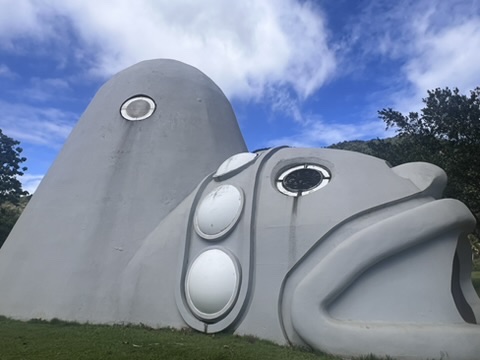
Jayuya is the only Puerto Rican town that still hosts an annual Indigenous festival. So, Museo El Cemí became the natural place to keep all the historical Taíno artifacts, Gonzalez said. But even the massive rounded gray museum is a mix of old artifacts and contemporary interpretations. The museum’s centerpiece is a larger-than-life jute and cotton costume modeled for Hura, the Taíno goddess protector of the conuco plant.
The Adrián Torres Torres Elementary School in the neighborhood hosts a fashion show every year, and the winner’s costume is displayed front and center in the museum’s main hall. Around the top floor of Museo El Cemí, photos from annual parades pepper the walls. The museum is an archive of Indigenous findings, but also a collection of how modern understanding of “Taíno” means nearly as much as its past.
Whether Taíno or Boriquen, the Indigenous Puerto Rican people have still left an indelible mark on the archipelago. Words like “barbeque,” “guava,” “iguana” and “canoe” come from native Puerto Rican origin. At the 2026 Super Bowl, Bad Bunny sang “El sol es Taíno,” —the sun is Taíno — from his song “El Apagón,” broadcasting the Indigenous identity to millions. Every day, hundreds of tourists who are unaware of the Taíno discourse leave the archipelago with tote bags, T-shirts and postcards marked with their symbols.
“We say modern Puerto Ricans are a blend of three things: Taínos, Africans and the Spanish,” says Michelle Amador, a worker at an Old San Juan shop selling artisanal goods with Taíno symbols. “So, even though physically we don’t look like Taínos, it’s still part of our blood and a part of our culture.”
Naisha Roy is an investigative specialization graduate student at Medill.