
By Conner Dejecacion
Medill Reports
It wasn’t a traditional video game.
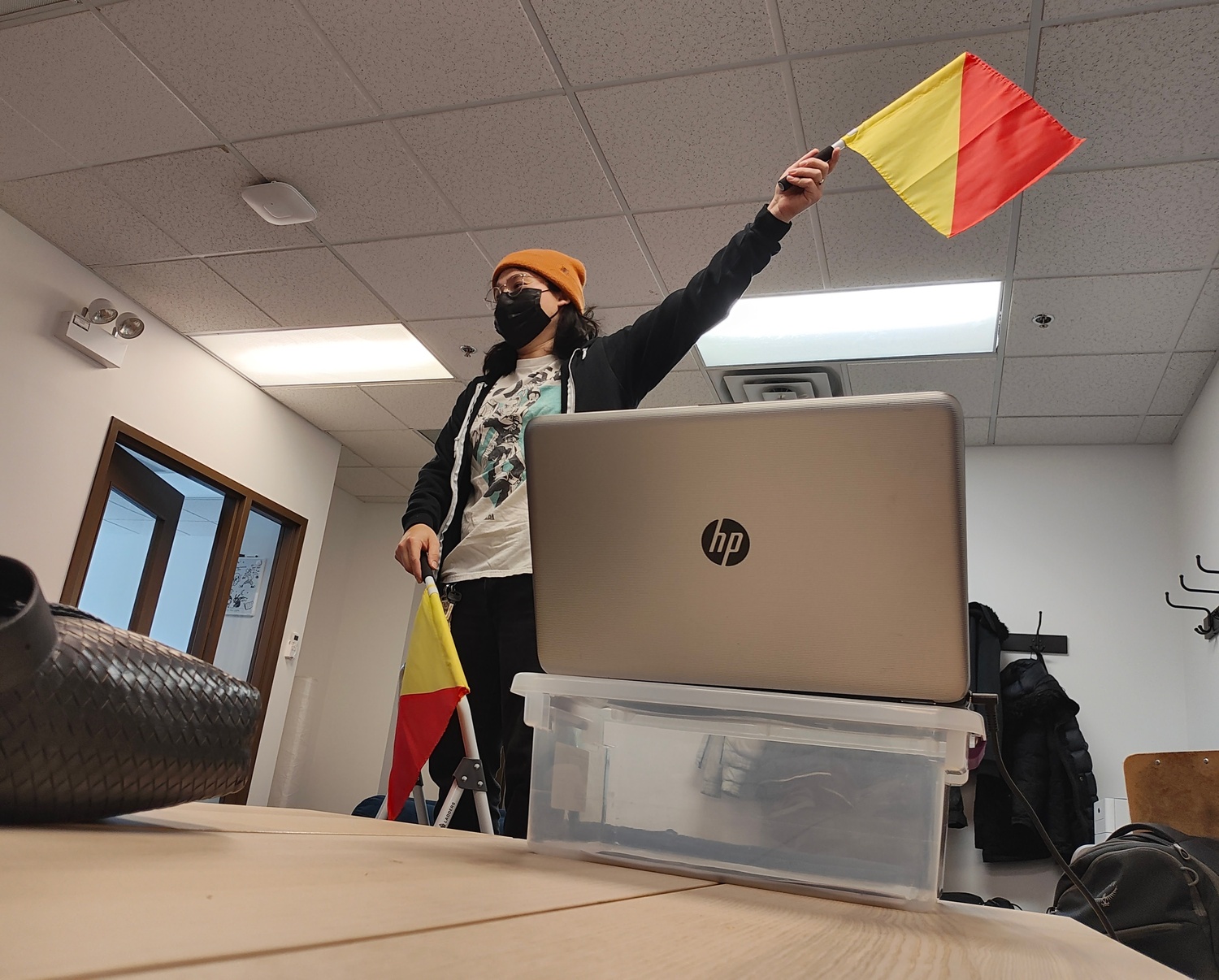
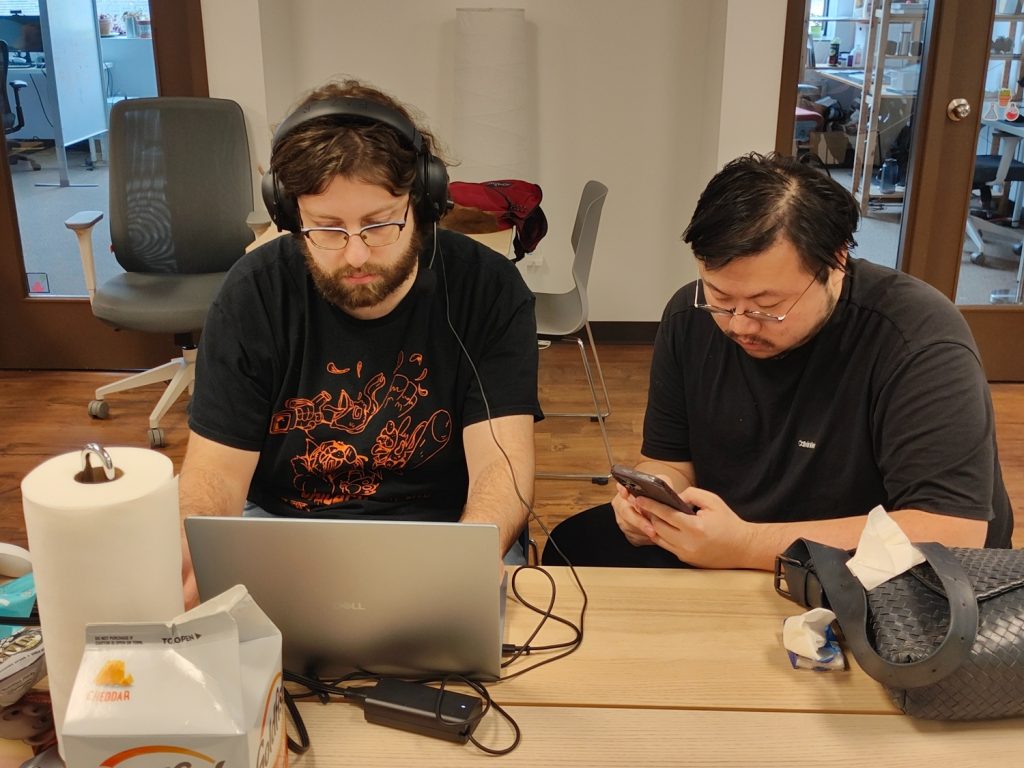
Two guys huddled over a laptop on one side of the room, the computer wired to a do-it-yourself interface consisting of huge, domed buttons in red, yellow and blue. Meanwhile, another person stood on a step stool, waving semaphore flags.
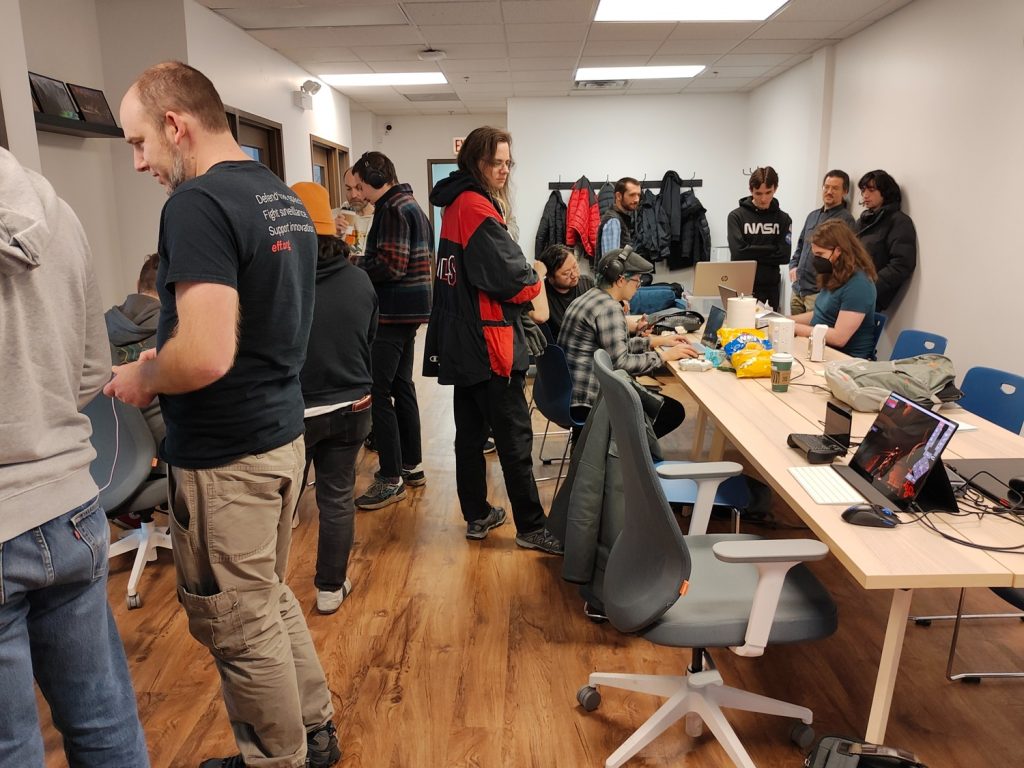
At the same time, a dozen others were playing a virtual card game designed for blind people, a slow-motion action game set in an “Inception”-like haunted house and a party game in which costumed kids compete to trick-or-treat the best — robbing one another of hard-earned candy.
Ari Garcia-Chow cried in delight as her teammates understood the messages she conveyed by waving the flags she held. Designer Asher Stuhlman stood to the side of the game, arms crossed, observing the game he created. This was at a playtesting event Feb. 21 at the Chicago Game Lab. Everyone was playing, yes, but when it comes to the video game industry, play is also work.
The Chicago Game Lab is a coworking space nestled between a veterinary hospital and a dental practice on West Irving Park Road, where independent video game developers make magic. Fifteen minutes away, on West Wrightwood Avenue, behind an unassuming brick facade, is Night City, where events like “Robot Karaoke” celebrate the local gaming community and give artists and players chances to connect. This June, Indie City Games, the organization that serves as a nexus for developers across the city, plans to open a new Kickstarter-funded game development hub. Gamedevmap, which tracks the geographic distribution of video game developers, counts 49 teams in its entry for Chicago — certainly an underestimate.
Gaming giants like Electronic Arts might be at home on the West Coast, but a growing number of independent developers and small teams are taking their laptops and massive charging bricks to the Great Lakes instead.
“There’s a scrappy underdog element that we all want to embrace,” said Tom Eastman, president of Trinket Studios and a cofounder of the Chicago Game Lab. “There’s been an ebb and flow to Chicago game development, from triple-A to indie and maybe back, mixing it all up in that history of the arcade to now.”
Even freelance developers find community in Chicago — they share both the desire and drive to create weird, exciting projects players won’t find anywhere else.
Brady Soglin, a solo developer who before 2025 had only released a few small projects on gaming platforms itch.io and Steam, launched Tall Trails last year to “Overwhelmingly Positive” reviews. The distinction, awarded by Steam to games with at least 500 reviews, 95% of them positive, is a badge of honor. He attributed the game’s success partially to the support of Chicago friends who gave him an outside perspective when they tested the game.
“Having people around you to ground you and inspire you and push you towards realizing your vision, which is very difficult when you’re this close to it, is really useful,” he said. “I think the game ended up being a lot better.”
Shared workspaces across Chicago like the Game Lab and the upcoming Lair, planned by Indie City Games, allow game developers to get out from behind their computer screens, and to meet and support one another. With individual offices and common workspaces available to rent or use during open work days, teams without a place to call their own can uplift one another and help make video games.
“Just being able to know, ‘If you’re doing this thing, you should go talk to this person,’ and having a physical space, I think, really helps with that,” Eastman said.
Nonprofit Indie City Games, which got off the ground in 2023,, links gaming professionals across Chicago. From a Discord server of nearly 1,850 members, ICG coordinates virtual and in-person events, including the yearly Chicago Indie Game Showcase. The convention, held every fall, has nearly doubled in size over the past two years, according to Seb Galvez, an ICG director. ICG connects developers to jobs and one another while providing a venue for sharing and showcasing work.
“What is fundamentally special about games as a medium is that they have a means to bring people together that nothing else really does,” Galvez said. “We try to be the hub for everyone to meet up and find common ground.”
Rob DiSalle and Bilal Yassine, two friends from Ohio who now make games together in Chicago, see the city’s development scene as intrinsically different from the industry’s power base. It’s “artsy, grassroots, and punk-like,” compared with LA’s more commercial, tech-oriented environment, Yassine said. Both developers pointed to Indie City Games as crucial for keeping the scene from going corporate.
“When we were at (the Game Developers Conference in San Francisco), I think half the conference was dedicated to how you can use AI in gaming. I think if you mention AI in the Indie City Games Discord, you get kicked from the server,” Yassine said.
The game developers of Chicago, making their way through “the city of the big shoulders,” as Galvez put it, are each doing their part to collectively advance video gaming as an art form. Night City, a peer and frequent partner of ICG, focuses on this artistic potential.
David Antognoli, an assistant professor of game design at Columbia College Chicago, runs Night City and its in-person events, which blur the line between gaming and performing arts. For instance, on Feb. 7, Night City hosted a game called Bloodrage Summer Fight Club, which had participants compete by punching a real, physical punching bag. Smaller, weirder games like Bloodrage Summer Fight Club serve as a contrast to traditional big-budget games players experience primarily as commercial products.
While such a game would never make it to a commercial market, events like these engage developers who want to experiment with forms of interaction that go beyond PCs and PlayStations. Furthermore, Antognoli keeps events at Night City free or low cost, which lowers the barrier to entry. He sees Night City as a node in a broader network of like-minded Chicago creators contributing to the medium every day.
“All of the sum of human activity is creating this chaotic beauty,” he said. “Something about this place adds some grit and resilience and determination to persevere, even though we’re not on the biggest stage.”
Conner Dejecacion is a magazine specialization graduate student at Medill.