
By Madison Roth
Medill Reports
A black-and-gray face with horns sprouting out of its head paints the upper arm of Minister Sharper’s right arm. Red flames poke out from the undone buttons of Sharper’s shirt, revealing a black barbed-wire heart on their chest. Their black jean jacket is littered with pentagram patches.
It might not be a surprise to learn Sharper belongs to The Satanic Temple Illinois, one of the congregations connected to the non-theistic religious organization The Satanic Temple. But a bystander wouldn’t know Sharper is the Illinois congregation head because only the people closest to Sharper know they identify as a non-theistic Satanist. Sharper isn’t their real name, rather a “Satanym” used to protect their identity.
Sharper doesn’t believe in Satan – none of The Satanic Temple members do.
To them, Satan is a metaphor, a symbol that embodies the values of the organization. Satan is the original rebel, a character they admire for going against the norm. The group believes in creating a safe space for anyone interested in exploring religious pluralism, or the acceptance of multiple religions coexisting at once and treating believers of those religions with respect.
But doing so can be difficult in this day and age. Christian nationalism, a political ideology merging Christianity and American identities, has risen since President Donald Trump retook office in January 2025. About 30% of Americans express ideologies that align with Christian nationalism, and the Illinois Satanists are living the repercussions. Despite the fears expressed by The Satanic Temple members on being out as a Satanist, the organization has also seen its numbers steadily growing.
“The individual members can be incredibly diverse in their opinions and interpretations,” Sharper said. “We’re not telling anyone how to think; we’re trying to find community together and support the idea of religious pluralism.”
Satanists who don’t believe in Satan
The national Satanic Temple was founded in 2013 by Doug Mesner and Cevin Soling, more commonly known as Lucien Greaves and Malcolm Jarry, who remain the organization’s leaders today. Greaves has publicly said he started The Satanic Temple as a social activism group, but it quickly morphed into something more than that. Headquartered in Salem, Mass., The Satanic Temple has 38 congregations across the globe. Each congregation is required to have regular meetings and some sort of leadership structure. Other than that, congregations are allowed to function however they choose, according to Sharper.
There is not one member in the entire organization of The Satanic Temple who believes in the existence of Satan, according to their official website, and people who do will be turned away from the group. The organization roots its beliefs in tenets that emphasize empathy, bodily autonomy, a person’s own freedoms and a belief in science. Each congregation of The Satanic Temple follows seven specific tenets that coincide with their group, according to the organization’s website.
Satan as a symbol may carry a different meaning to each The Satanic Temple member but represents a rebellious figure. Members often reference “Paradise Lost” by John Milton as a model for how they view Satan. In the poem, Milton portrays Satan as one of God’s most beloved angels who is misunderstood and is a rebel at heart. He is a complex character driven by his individual goals. The work is often linked to the Romanticism literary movement, and The Satanic Temple refers to their beliefs as Romantic Satanism.
The Satanic Temple doesn’t recruit members but are open to talking about their beliefs with anyone who inquires. The organization lets any prospective members reach out to them if interested in joining.
Another pillar of The Satanic Temple is its desire to be seen as equal to other religions, as they believe every religion should have a place in social and cultural settings, not just Christianity, Sharper said.
For The Satanic Temple Illinois specifically, members have petitioned to deliver invocations, a prayer or moment of reflection, at the beginning of Chicago City Council meetings a few times. A range of members from different religions have given invocations at these meetings, but in 2024, The Satanic Temple Illinois ministers were denied. It’s one of the many lawsuits the national organization has been involved in over the years.
“We have a right to follow our religion, according to the Constitution,” Sharper said. “If one has a right, everyone has a right.”
Your friendly, local neighborhood Satanist
One afternoon in February, Sharper sat at October Cafe in North Park, drinking a taro latte and described what they did with their wife for Lupercalia, an ancient Roman holiday Satanists celebrate the day after Valentine’s Day to mark one’s bodily autonomy. They said they performed a small ritual with their wife and enjoyed a nice dinner together. Other members performed their own rituals, spending the holiday as a community, Sharper said.
The 44-year-old is a registered minister of Satan. They’ve been a part of The Satanic Temple Illinois for five years, and the congregation head of The Satanic Temple Illinois for a little more than three. Their wife, Riley, is also a registered minister of Satan and was the head of The Satanic Temple-Indiana before moving to the Illinois congregation. Sharper also has a role in the international Satanic Temple congregations and is the co-director of the Satanic Good Works program, The Satanic Temple’s volunteer branch.

Beyond their work with the Satanic Temple, Sharper has a day job and lives in a northwest neighborhood of Chicago. The other members of The Satanic Temple Illinois interviewed for this article are in similar situations as their leader.
Sharper said most of the 130 members of The Satanic Temple Illinois live in Chicago or its suburbs with a few scattered around the state. Several members get together for internal rituals the organization hosts, including unbaptisms. Sharper said unbaptisms are a way for people to “shake off” their baptism as children.
“A lot of people were raised in the church,” Sharper said. “After they lose faith, they miss that sense of community and want a place where they can start over.”
In these unbaptism rituals, members may choose to be marked with ashes of burnt Bibles, according to Sharper.
The Satanic Temple members also engage in social activities like bowling, book clubs and game nights, according to The Satanic Temple Illinois member Istus Alegria.
Alegria, which is her Satanym, said she has been a member of The Satanic Temple Illinois since 2022 and has enjoyed finding a place focused on community. Alegria said she doesn’t fully resonate with Satan as a symbol, but she loves The Satanic Temple because of the freedom she has to be herself and she admires the seven tenets.
To the 45-year-old Elgin resident, the seven tenets are simply how to be a good person, and she believes the way The Satanic Temple operates is common sense. But Alegria is cognizant of the negative connotations that come with being a Satanist since Christianity has “been the only narrative for so long.”
She said people never know when a Satanist is around them, though, because in her opinion, they look like everyone else.
“Every Satanist is just a person who has a background, certain traumas, likes and dislikes, and they’re just like everyone else,” Alegria said. “They just have some part of The Satanic Temple that speaks to them.”
For member Nerpenov II, his Satanym, The Satanic Temple’s push for religious equality stood out to him. He became interested in The Satanic Temple when he saw the news about The Satanic Temple Iowa displaying a Baphomet statue, a goat-headed figure connected to the occult, in Iowa’s state capitol building for Christmas in 2023. That event was his introduction to The Satanic Temple, and he quickly looked into The Satanic Temple Illinois and how to become a member.
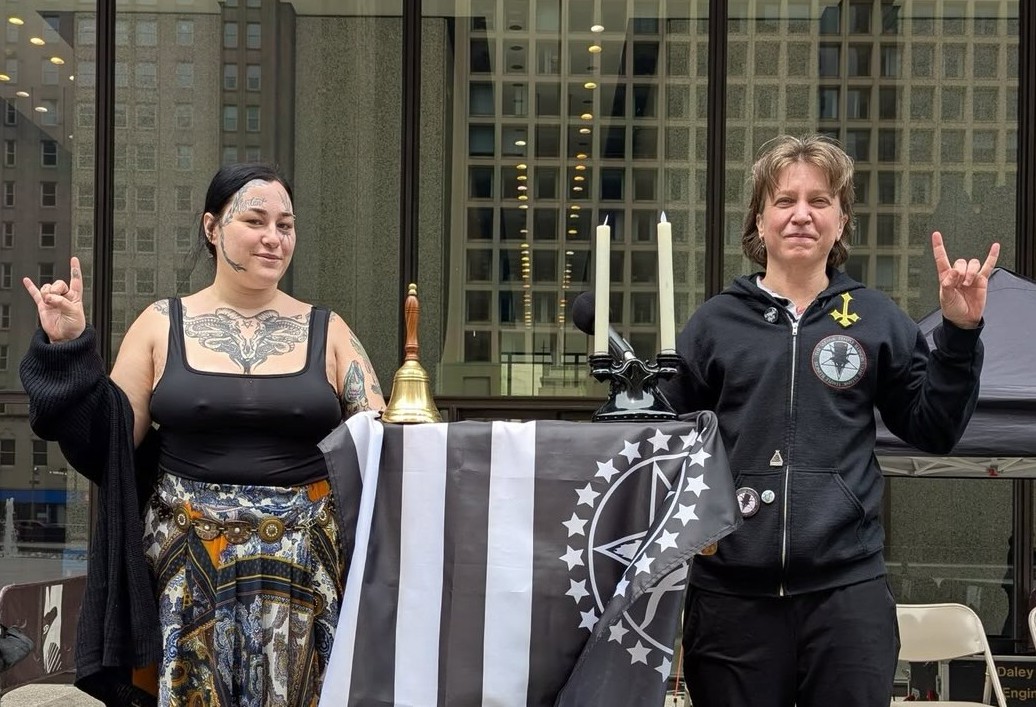
Since he joined, Nerpenov has been a part of several public The Satanic Temple Illinois events, such as their Meet A Satanist at The Brewed Coffee in Avondale; a public reading at the Daley Center from “The Revolt of the Angel,” a 1914 novel depicting God’s angels revolting against him so Lucifer can rule Heaven; and a Q&A at the Leather Archives and Museum with a Satanic Panic movie marathon, where an unbaptism was performed afterward for anyone interested.
Nerpenov, who is 36 and lives in a southwestern Chicago suburb, said one of his favorite parts of being in The Satanic Temple is being able to follow his own moral compass and not having a “God” tell him how to live. He said he believes Satan is a form of self- empowerment as the original rebel.
Growing up Catholic, Nerpenov didn’t like the hypocrisy he saw in the Bible. He said he saw Jesus saying be good to others but then saw people around him claiming to be Christian not doing that. Satan was a scapegoat for evil to Christians, Nerpenov said.
“If they don’t have a bad guy to scare them, why listen and follow God?” Nerpenov said. “They need someone to blame for all the bad things.”
Sharper has witnessed firsthand the pushback The Satanic Temple Illinois has gotten from those who oppose the existence of the organization, like when people come to protest their Meet A Satanist events. They said there is danger in being out as Satanist — only a few members of The Satanic Temple Illinois are open about that part of their lives.
But Sharper said they will continue to fight for what they believe in, expressing their belief “Satan is a reasonable guy” and their willingness to talk about their Satanism with people who “bring a genuine curiosity.”
“We’re pushing for the good of everyone,” Sharper said. “We’re trying to make religion an open and welcoming space for everyone.”
Former congregation head of The Satanic Temple Illinois Adam Vavrick said he first became involved in The Satanic Temple because he was interested in the 7-foot-tall Baphomet statue placed on the grounds of the Oklahoma state capitol in 2014, in protest of the building’s Ten Commandments monument.
Vavrick said he shortly joined The Satanic Temple after reading about the statue because he just “got it.”
“I understood the point of going into a space that is open to all and saying, ‘I wanna be here, too,’ and then watching everyone go ‘Wait, we don’t want you here,’” Vavrick said.
Even though he is no longer a member of The Satanic Temple, Vavrick said he still leads a Satanic life, often reflecting on the time he spent helping others and his own growth.
“I’ve been unabashedly who I am for way longer than I was a member of The Satanic Temple,” Vavrick said. “The Satanic Temple fit really well into a mold that I was already walking.”
The Illinois Satanic Temple’s tumultuous past
Vavrick used to be the congregation head of The Satanic Temple Illinois before leaving in the summer of 2024 due to disagreements with management decisions. He said there were certain members who either resigned or were removed from the congregation because of the ramifications from these management decisions. Vavrick has been known not to shy away from speaking bluntly, and when he couldn’t come to an understanding with the other leaders, he resigned.
The summer 2024 decisions led to a religious schism, or a split between opposed members of a group. In response, the Illinois Satanic Collective was created by those who left The Satanic Temple Illinois. Vavrick is not involved in this new collective.
While being interviewed for this article, some past and previous members of The Satanic Temple Illinois have alluded to decisions being made by Greaves that trickled down into the congregations as the reason for why this schism took place.
But all religions go through schisms, and The Satanic Temple is no different, according to Dr. Joseph Laycock, associate professor of religious studies at Texas State University. The Satanic Temple has had several schisms over the years because “Satanists don’t play well together,” he said.
Despite the split from The Satanic Temple Illinois, Mike Tauler, a member of Illinois Satanic Collective, said the organization shares a lot of DNA with their former group. Tauler and others in the ISC didn’t explicitly leave The Satanic Temple because of anyone in the congregation but because of differences in opinion with how the organization should be run.
“Members of The Satanic Temple are fellow Satanists,” Tauler said. “We hope one day to work with those individuals. We don’t hold any ill will towards any individual members.”
Leaving wasn’t easy for members of Illinois Satanic Collective, but Tauler said he’s proud of how everybody in the group has stepped up and come together.
“It’s meant everything to have this community, especially in the time we were splitting from The Satanic Temple,” Tauler said. “There was a lot of uncertainty. We didn’t know what we were going to do to hold the community together, and our community had pulled together to give that space to ourselves and each other.”
Illinois Satanic Collective has been around for two years and is in the process of becoming a non-profit organization. Unlike The Satanic Temple Illinois, there is no hierarchy of membership in Illinois Satanic Collective. Tauler said the group is open to new ideas and thoughts, urging members to have civil conversations if they don’t agree with everything the group does. People who are uncomfortable with being labeled Satanists can join as long as they respect the values of the group, Tauler said.
“We’re a community; we’re a group of friends,” Tauler said. “We choose to be a chosen family, so all the things you celebrate normally as a family we celebrate together.”
Non-theistic satanism tends to attract people who are already marginalized, Tauler said, and the religion doesn’t judge anybody who society sees as different. He has a snake and apple tattoo on his forearm as an everyday reminder of that.
“Being your true and authentic self will often put you at odds with society,” Tauler said. “But we welcome that here.”
A religion or a provocation?
Laycock is the only person who has academically written a book centered around The Satanic Temple. Published in 2020, his book “Speak of the Devil: How the Satanic Temple is Changing the Way We Talk About Religion” gave insight on who The Satanic Temple is as a group and the religious boundaries they’ve been pushing since being founded.
The United States Supreme Court has never defined religion, and Laycock said The Satanic Temple is forcing this conversation on what is religion and what it means to have religious freedom.
Laycock said the organization of The Satanic Temple as a group at large has bigger implications than what people realize.
“To me, what The Satanic Temple is doing is really important and it’s forcing people to think about what do we actually mean when something is a religion or not?” Laycock said.
But Laycock acknowledged the downsides that can come with identifying as a Satanist. He said he attended The Satanic Temple events in Texas that were meant to act as a shock factor to Christian protestors and saw members use this shock as a way to ignite change. However, it’s the shock factor that causes people to not take The Satanic Temple seriously as a religion, Laycock said.
That shock factor is what turns off people like Jon Trott, a Christian who studied Satanism for a decade and wrote the book “Selling Satan: The Evangelical Media and the Mike Warnke Scandal.”
Trott said he views Satanists as people who are sticking their tongues out at those who oppose them, doing whatever they want to do as radically as possible.
“They’re using the devil as a cultural tool to make their point,” he said.
While Trott said he doesn’t understand what drives someone to become a Satanist, he does respect The Satanic Temple Illinois’s fundamental ideas of what it means to be a good person.
While attending different The Satanic Temple events in different states, Laycock has seen all sorts of people show up. Sometimes people come to protest events while others come to watch because they’re interested in what’s going on, he said. He said he spoke to Christians who were protesting because they believe The Satanic Temple is going through spiritual warfare and need to be stopped. But Laycock said he’s never seen any Christians at the events he’s attended talking to a Satanist. To him, many Christians just want to be angry at Satanists for going against God.
Theistic Satanists are pretty rare, according to Laycock, but most people may think of sacrifices and people being murdered when they think of people who worship the devil. Laycock said so much of Satanism is linked to people who have murdered in the name of Satan, like serial killer Richard Ramirez.
“There’s a potential double standard here because we don’t judge Christians by Christian serial killers, like the Ku Klux Klan or the Westboro Baptist Church,” Laycock said. “But associating yourself with Satan has a lot of risks that come with it and may ultimately backfire.”
Life as a modern day non-theistic Satanist
Nerpenov owns a few The Satanic Temple shirts and keeps Satanic pins on his jean jacket, similar to Sharper. He isn’t open about being a Satanist at his job but will talk about it if people ask. Algeria, on the other hand, will say she’s in The Satanic Temple Illinois but doesn’t go out of her way to let anyone know.
Satan remains a symbol of cultural fear in the country, especially with Trump being vocal about implementing laws that align with Christian values and beliefs. According to a study done by PEW Research, 62% of Americans identify as Christian, 28% identify with no religion and 8% identify with other religions. Sharper said the more Trump puts Christian ideals into law, the scarier it gets to not be a Christian.
Sharper said they believe Satan is a direct threat to Christianity, and he remains a symbol of fear because people cannot get outside of their own views, unable to stop their panic enough to see another perspective.
Regardless of outside pushback, The Satanic Temple Illinois is going to keep going, Sharper said, because they believe in fighting back against authority. The Satanic Temple is still a relatively young religion, and internal parts of the group are still adapting and evolving as their needs change, Sharper said.
“Sometimes being an adversary is the right path; sometimes pushing back is the way to make things fair for everyone,” Sharper said.
Madison Roth is a Medill Investigative Lab-Chicago specialization graduate student at Medill.