
By Jonah White
Medill Reports
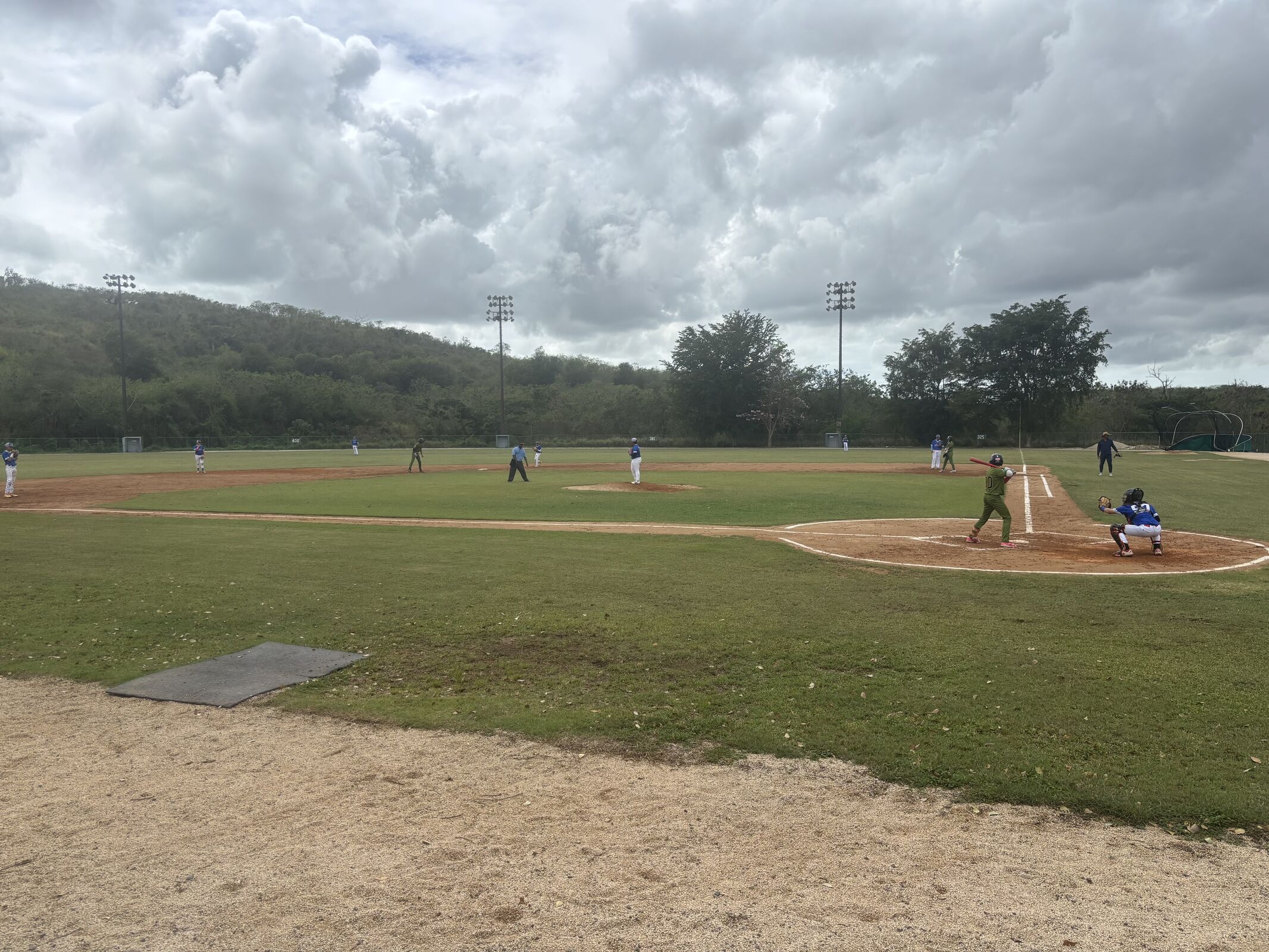
Third baseman Angel Rosario snaps into action. There’s a runner on second base, so he has to hurry on an otherwise routine ground ball.
As Rosario fires across the diamond, the runner takes off for third. He dashes back to the bag, catches the return throw and completes the tag for a spectacular 5-3-5 double play.
It’s 1 p.m. on an 80-degree Thursday in February, and Rosario is 15 years old.
He is one of 138 students at the Albergue Olimpico Baseball Academy in Salinas, Puerto Rico, which seeks to develop potential college and professional baseball players, while giving them the education and values they’ll need for success off the field. The students hope to follow in the footsteps of Puerto Rican baseball legends like Francisco Lindor, Carlos Beltrán and, of course, Roberto Clemente.
AOBA, as it is known, is a baseball academy for seventh through 12th graders, where the players live and take classes during the week. The academy is located in the mountains of Puerto Rico’s southern coast, a part of the island historically known for polluting coal and oil plants more than unspoiled beaches.
When the U.S. annexed Puerto Rico at the end of the 19th century, it began an era of subordination that continues to the present day. But in addition to political repression, military bases and various forms of economic extraction, Americans brought something else to the island: baseball.
In some ways, baseball can be seen as a microcosm of the disenfranchisement of Puerto Ricans throughout the island’s time as a U.S. territory.
In 1990, Major League Baseball began making Puerto Ricans participate in the MLB draft, unlike foreign players. Many argue this put the island at a disadvantage, because it had fewer resources to develop players than the mainland U.S. but their players were now being treated the same.
Foreign players can sign with teams directly when they are 16 years old, making it more worthwhile for teams to invest in their scouting and development. The result is Puerto Ricans have fewer resources than players from the mainland, and more restrictions than players from other countries.
Nonetheless, Puerto Rico continues to be a rich source of major league talent. Its team advanced to the quarterfinals of the World Baseball Classic in March, despite the absence of star infielders Francisco Lindor and Carlos Correa, both of whom were refused insurance for their contracts through Major League Baseball and subsequently barred from participating by their MLB teams.
After Puerto Rican closer Edwin Díaz’s catastrophic injury at the 2023 World Baseball Classic, MLB’s insurance partner refused to insure the contracts of players it deemed at a high risk of injury in the competition. While other teams had players affected, no roster was as devastated as Puerto Rico’s. Many fans in Puerto Rico understood and expressed frustration with their team’s situation. Blue and red “PR” caps are not hard to spot on the island.
In January, outfielder Carlos Beltrán became the sixth Puerto Rican elected to the Baseball Hall of Fame.
Athletics’ infielder Darell Hernáiz was the latest to make headlines after his walk-off homerun against Panama in the World Baseball Classic at Hiram Bithorn Stadium in San Juan.
Hernáiz, like Lindor, went to high school in the mainland U.S. But Correa, the first overall pick in the 2012 MLB draft, attended the Puerto Rico Baseball Academy, which was founded in 2001 in Gurabo, inland on the eastern side of the island. The Carlos Beltrán Baseball Academy was founded 10 years later in the municipality of Florida, in the north-central part of Puerto Rico, with the support of the Hall of Fame outfielder. Those two academies have created pathways to professional baseball, but there is a need for more on this baseball-rich island of 3.2 million people.
Angel Molina founded AOBA in 2020. Molina, 44, has a presence and enthusiasm that makes one imagine what he must have been like as a catcher for the Double-A Carolina Mudcats (then a Marlins affiliate) 20 years ago. Molina’s own career was cut short by injury as he was on the cusp of an opportunity in the major leagues, but he found a new purpose in coaching, and eventually it brought him to start AOBA.
Molina hopes to have many of his current players follow in the footsteps of Yanuel Casiano, who was drafted by the Cincinnati Reds after graduating from AOBA in 2024. But he wants to prepare them all for life outside of professional baseball too. His philosophy includes instilling values like discipline and hard work that will help his players after graduation. His son graduated from the academy in 2023.
Part of the AOBA campus is a cluster of classrooms, adjacent to one another in a small building near the front of the complex. On a warm February morning, Karen Rodriguez, the science teacher, had just finished a lesson on molecular bonding, and her classroom was full of colorful foam models of oxygen, hydrogen and carbon dioxide molecules.
Rodriguez came to AOBA from Puerto Rico Youth College. She said she enjoys the interactions with students and is impressed by how the program is able to blend the educational aspect in with the baseball training.
Between class, baseball practice and conditioning, a day at AOBA is full of activity, but little free time.
Erick Zornosa, sitting across a table in a spacious room outside Molina’s office in February, described a typical day. It starts at the gym, and then he goes to class for four hours in the morning. After lunch, he does infield or batting drills. He does his homework in the evening.
“The hardest part is waking up at 3:30 in the morning to go to the gym, but you can get used to it,” he said.
Zornosa, from San Germán on the southwest corner of the island, said he came to AOBA to improve his skills “so hopefully I can one day fulfill my dreams of becoming a professional baseball player.” He has already visited the universities of Florida, Georgia and Texas, and he wants to go to school in one of those warmer states.
The school is situated within the larger Albergue Olimpico complex, founded in 1985, where Puerto Rican Olympians train in various sports. As with the World Baseball Classic, Puerto Rico competes as its own team in the Olympics. Athletics has always been a source of pride for the island.
The entire campus is vast and sloping. It includes an Olympic-sized swimming pool, a shooting range, a track, and facilities for several other Olympic sports.
Having started AOBA in the complex five years ago, Molina has added basketball to the program. He intends to add swimming and women’s softball next.
The program costs $6,200 per year in a region where the median income is just less than $22,000. AOBA does not receive help from the government, Major League Baseball, or a personal endowment, like the Carlos Beltrán Baseball Academy on the northern part of the island.
Students are housed in dormitories that are adjacent to one another and accessed from the outside. Even some of the facilities that have roofs, including a basketball complex, are in the open air.
The coaching is a big part of the appeal of any sporting development academy, and Molina takes care to hire coaches with similar values.
On an 80-degree day in February, Carlos Perez Irizarry was taking in the game from the shaded bleachers up a hill from the third-base home dugout. The head baseball coach at AOBA, Irizarry, came from a different academy, but he was drawn to AOBA because of Molina’s larger vision, and the standards of the players. “The values for me is number one. Their attitude,” he said.
Aldemar Burgos was also in the bleachers. He’s the hitting coordinator. Burgos was drafted by the Padres in 2015 out of the Carlos Beltrán Baseball Academy and still plays professionally in the Puerto Rican Winter League.
“The art of hitting is very challenging because it’s about mechanics, but the mental side of hitting is for me the most important thing,” Burgos said. He reminds his players that even the best hitters fail seven times out of 10.
On the field, Staff Sgt. Hecmar Rodriguez stands behind home plate in his camouflage army uniform watching the game. His son, Ian, is playing on the same team as Angel Rosario. He said he likes the program so far because Ian “comes back independent and responsible.”
As he reminisced about his own playing career, Molina got out of his chair, took his batting stance and demonstrated what it was like to pimp a home run in a minor league game. He explained how the game turned into a passion as he finished his career. He shared the pride he felt when watching his son get a walk-off hit.
Molina was drafted in 1999. He played in the minor leagues until 2007 and in independent leagues in the mainland U.S. until 2013. He also played in the Puerto Rican Winter League from 2002 to 2012.
Asked what he does in his free time now, Molina paused for one second. “Baseball,” he said.
Jonah White is a sports specialization graduate student at Medill