
By Conner Dejecacion
Medill Reports
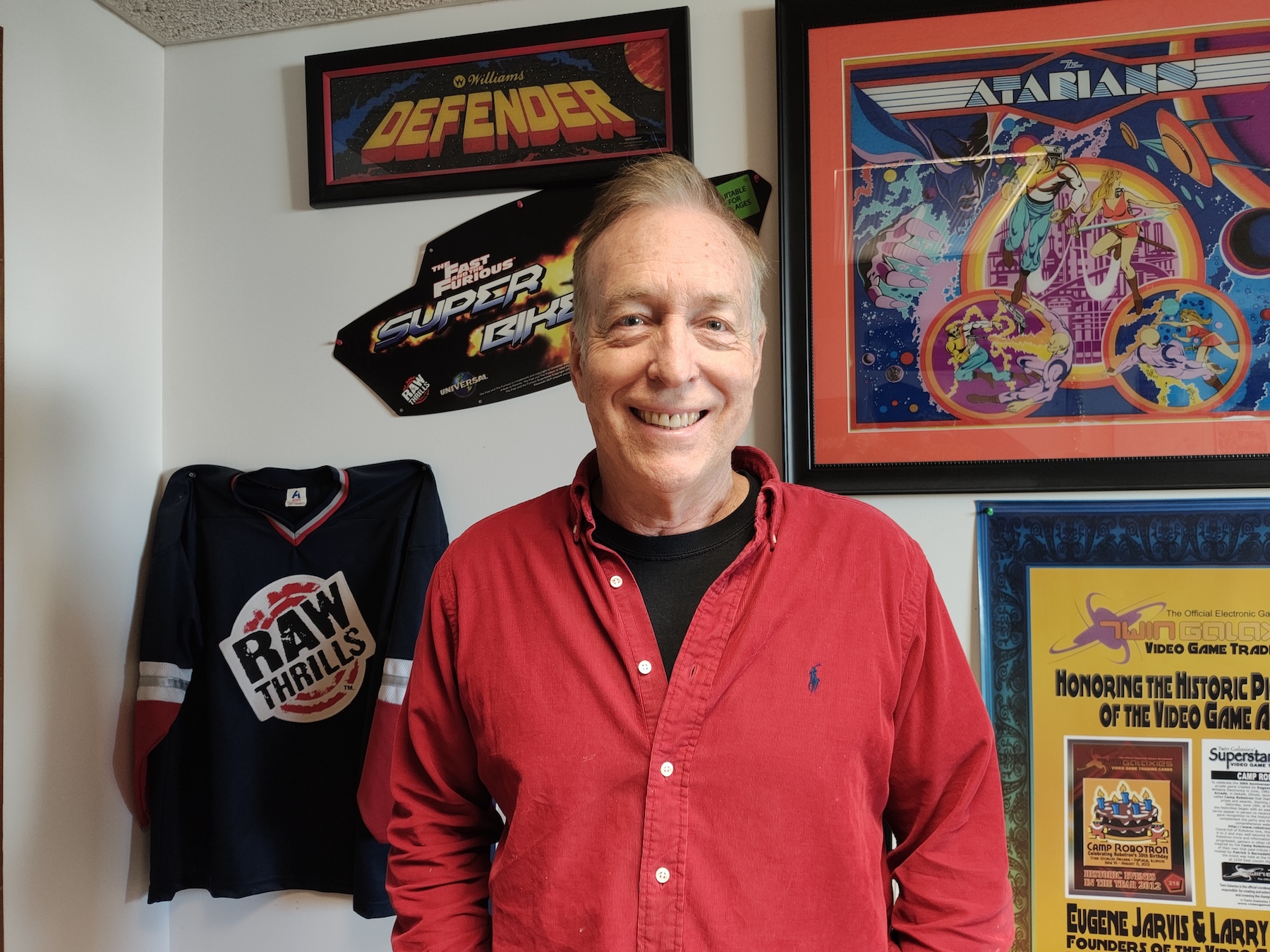
Eugene Jarvis, 71, has worked on video games since their inception. He grew up in Menlo Park, Calif., the heart of Silicon Valley. As a “young, rebellious” person living in the shadow of the Vietnam War, he played chess, invented war games out of bottle caps and explored the Bay Area on his bike. When he played Spacewar!, an early video game released in 1962, in a Stanford lab, he described it like “being on the set of ‘Star Trek.’”
After graduating from the University of California, Berkeley, in 1976 with a degree in computer science (and “minors in pinball and pool,” he joked), he cut his teeth developing pinball games for Atari, and later, Williams Electronics, where in 1980 and 1981, he and fellow designer Larry DeMar co-developed the arcade game Defender.
“We were the blind leading the blind,” DeMar said. “Our group had no idea at the start what we were doing or how to make a video game.”
Pushing through the challenges of rudimentary hardware, programming languages and an unconventional design, which featured complex controls and faster-paced gameplay than what arcade-goers were used to at the time, Jarvis and his collaborators managed to cobble together a classic game. When it came time to test the game in November 1980, DeMar said Jarvis skipped the showcase because he worried Defender would flop. His fears were unfounded — players lined up in droves to play the game.
“It was chewing up people left and right,” DeMar said.
Defender turned out to be a smash hit, grossing more than $1 billion. Williams sold tens of thousands of arcade units during the past 40 years. In 2000, the U.S. Postal Service even selected it as the first video game to be featured on a postage stamp.
Jarvis followed up Defender with Robotron: 2084 (also co-developed with DeMar) and Smash TV, a 1990 game in the same vein co-programmed with Mark Turmell, another developer who went on to create the successful NBA Jam. Turmell joined Williams in 1989, and when CEO Lou Nicastro announced a $40,000 bonus to whoever finished their game project first, Turmell teamed up with Jarvis, who gave him some wisdom that stuck with him ever since:
“He said, ‘You’ve got one cool thing here. A video game has 1,000 cool things in it. … And double the blood.” (Jarvis was an early pioneer in pixelated gore.)
Jarvis created his greatest hits far from Silicon Valley. The video game creator now lives in Chicago, where he runs his own 75-employee arcade game company, Raw Thrills, in Skokie.
“I was a bit of a fish out of water,” he said of his arrival in the Midwest.
Jarvis, who punctuates his stories with curses and wheezy laughs, remembered braving his first Chicago winter in 1979 and watching as feet of snow thawed to reveal “piles of dog[bleep].” Yet he praised what he saw as a Midwestern ethos unburdened by pretension and competition. In those days, he said, “You were just a guy doing s***.”
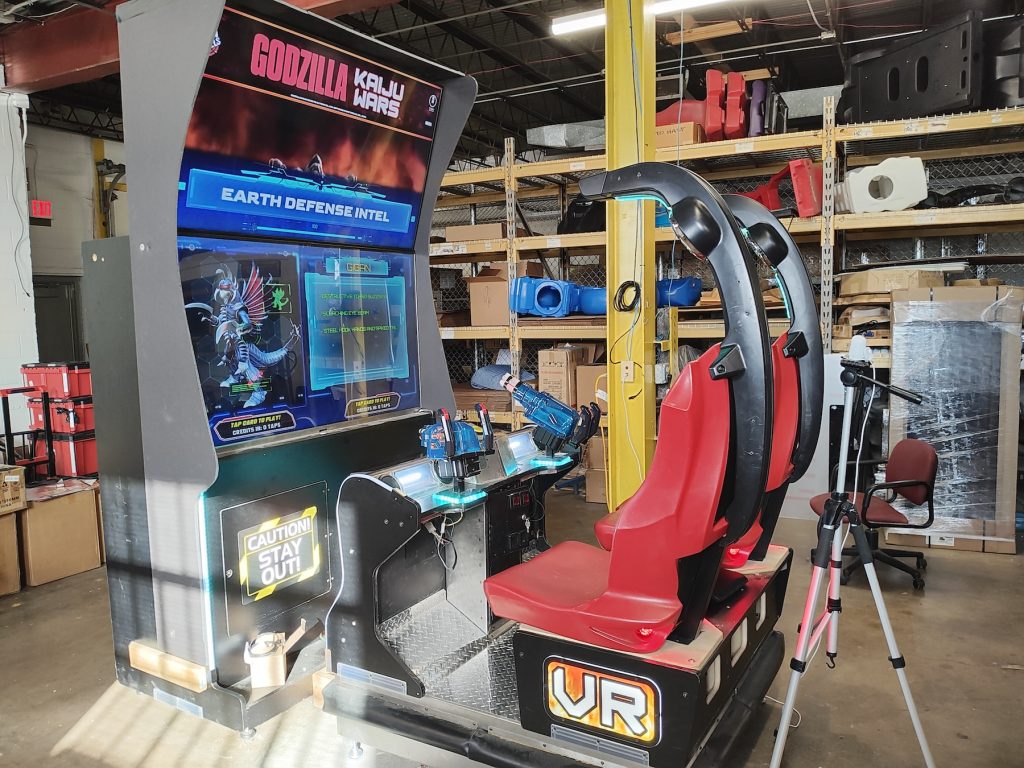
Raw Thrills is known for its licensed racing and action titles based on entertainment properties like “The Fast and the Furious,” Halo, “Jurassic Park” and “Godzilla.” Even with blue-chip intellectual property behind him, Jarvis is no stranger to courting controversy. Giggling like a boy 60 years younger, Jarvis remembered struggling to find business insurance for Raw Thrills because of its name.
“It was probably a little too pornographic,” he said, explaining the name was originally meant to be a play on competitor video game company Rare, known for the Banjo-Kazooie games.
For as much reminiscing as Jarvis does (he says he is still “addicted” to Robotron: 2084), he also looks to the future of the industry and his place within it.
Jarvis donated an undisclosed amount of money in 2022 to DePaul University, which renamed its college of computing to honor him. His wife, Sasha Gerritson, is a DePaul alumna, and Jarvis served as the university’s first Game Designer in Residence. Jarvis marked the gift, which was the largest such donation in the school’s history, surpassing the previous record of $30 million, as a shift in developing his legacy. In his early work, he said, “It was all about having the cool thing, creating the new thing.” With this gift, he said he hoped to pay some of his success forward by helping the people who are behind the product and cultivating the next generation of programmers and developers.
Aaron Zartman, a senior at DePaul studying game design, credits Jarvis’ gift with uplifting the program through the financial turbulence impacting other majors. He also points to new resources like the Jarvis Center, a collaborative development space opened in January 2023, as a major boon. “It kind of feels like I’m in this special major that gets all the special treatment,” he said.
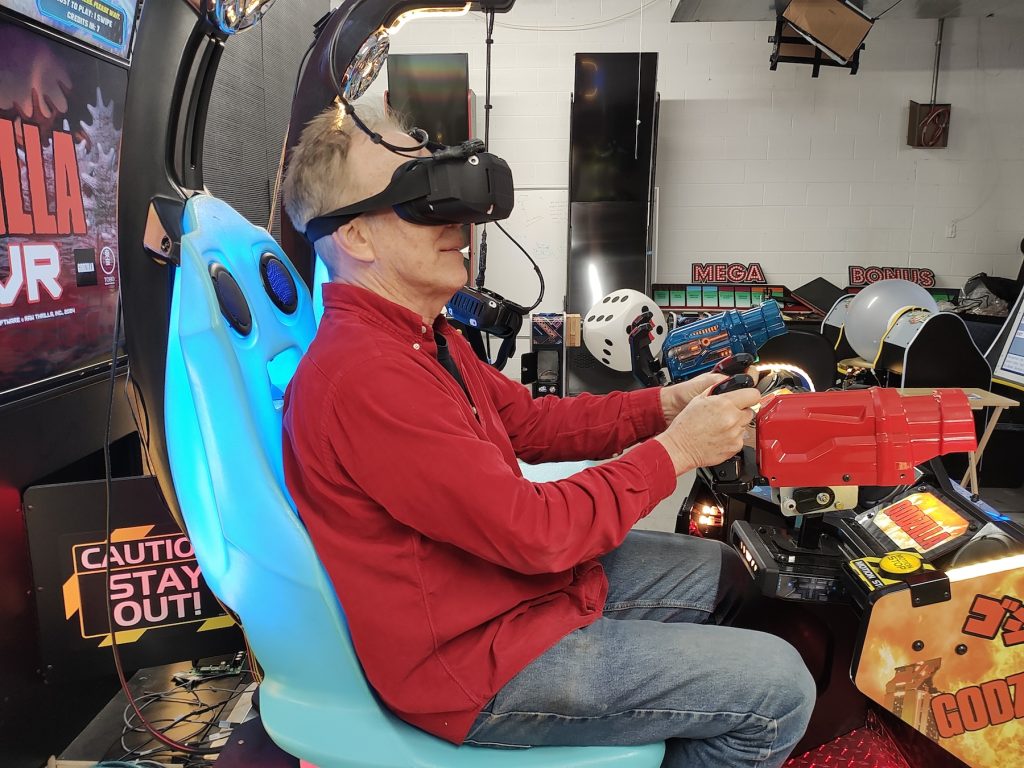
The Raw Thrills office, set on a quiet street in Skokie, is nearly an arcade itself. The studio’s latest prototypes strobe and flash enticingly next to the workstations where developers focus on bringing their games to life. Jarvis walks through the warehouse filled with his creations like Willy Wonka in his chocolate factory. Posters for Defender, Target: Terror and his other success stories line the walls of his office.
“I like video game history,” he said. “I’ve lived all that [bleep].”
And he still is.
Conner Dejecacion is a magazine specialization graduate student at Medill.