
By Tyler Williamson
Medill Reports
Cleveland police shot Timothy Russell and Malissa Williams in the parking lot of Heritage Middle School following a high-speed chase involving 60 police officers in 2012. The sound of a nearby car backfiring was mistaken for a gunshot. Thirteen police officers fired 137 times into the car where Russell and Williams sat, unarmed, killing them instantly.
The shooting sparked a federal investigation into the Cleveland Police Department and received national coverage. Sixty-three officers were suspended, and six were eventually fired.
The killings were a watershed moment for a city that had long been struggling with accusations of police misconduct, especially against Black residents. The U.S. Department of Justice launched a 21-month investigation and ultimately found police regularly used excessive force. The investigation led to a 2015 consent decree, wherein the city was ordered to undertake sweeping reforms around force, search and seizure, accountability, transparency and crisis intervention.
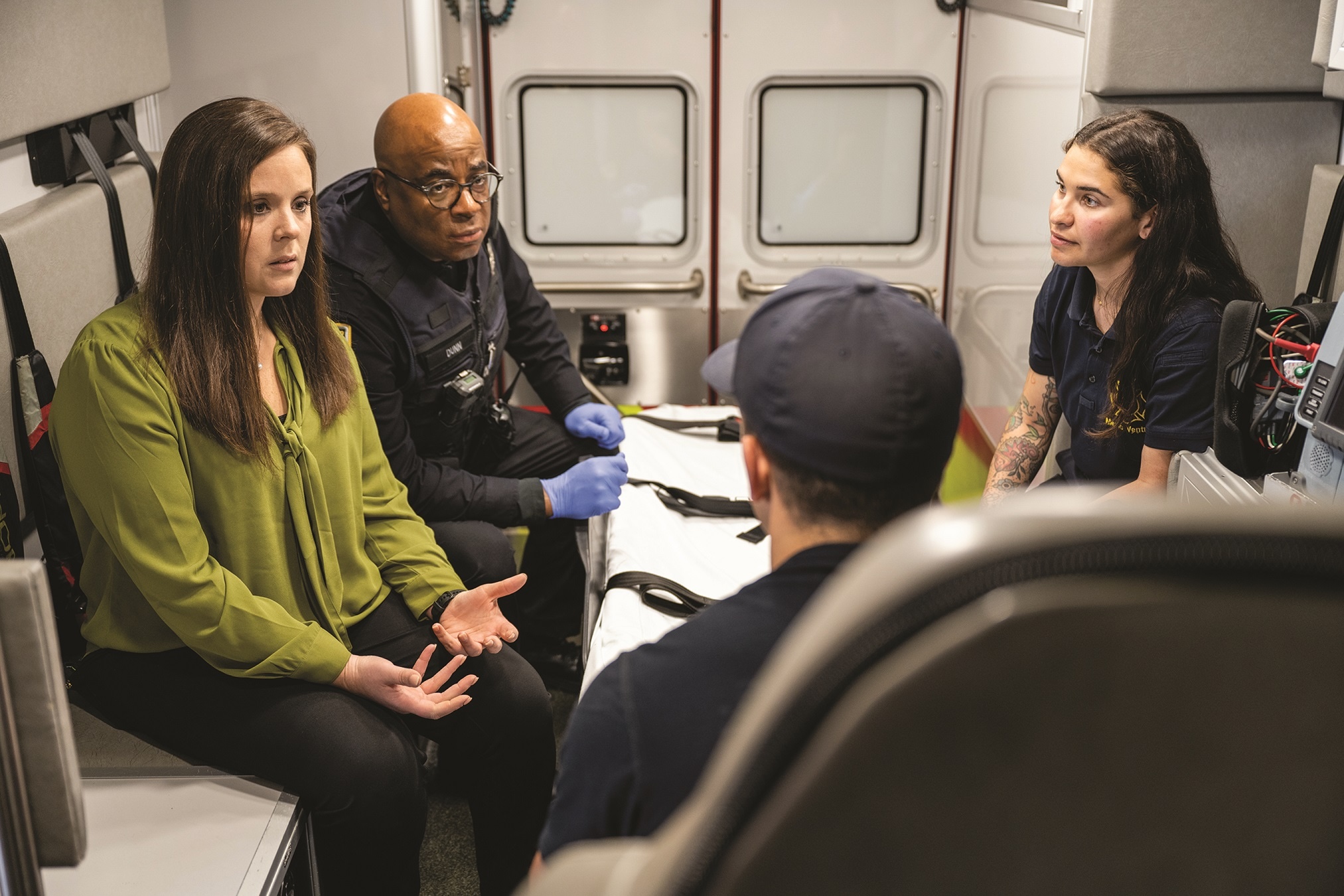
Cleveland has made reforms due to the consent decree and ongoing pressure from residents, including after George Floyd’s killing in Minneapolis launched a national movement in 2020. The reforms include a small program to address mental health crises without police, as well as a co-response program where clinicians join police in these situations. Cleveland suburbs also have a similar alternative response program. However, the reach and scope of the programs are still limited, as proponents and city leaders hope to expand in the future.
Co-response in Cleveland
After the consent decree mandated Cleveland start a crisis response program, the Alcohol, Drug Addiction and Mental Health Services (ADAMHS) Board of Cuyahoga County worked with police to get a federal grant to start a pilot co-response program with teams of a police officer and a licensed mental health clinician.
Cleveland’s co-responder program received a three-year Bureau of Justice Assistance grant in 2020. Angela Cecys was hired as a clinician on one of the five co-responder teams and now serves as the senior public health and safety strategist for the Cleveland Department of Public Health.
The consent decree also mandated Cleveland form a Mental Health Response Advisory Committee, which brings together mental health, substance abuse and treatment/recovery providers and stakeholders, the community and the police.
The committee’s objective is to build a better understanding among law enforcement of mental illness and related crises. The committee also makes recommendations directly to the police department regarding its policies, procedures and training for dealing with someone in crisis.
Cecys, responsible for overseeing the co-response program’s sustainability, said she feels it’s important to have police involved in crisis response spaces and advocates for Crisis Intervention Team (CIT) training, a curriculum used nationwide to help officers understand and deal with mental health issues.
“I’m a firm supporter of police being CIT-trained — as many officers as possible being CIT-trained — and of police co-response teams,” Cecys said. “I think when you have a full system of services and different levels of engagement, you have the right response at the right time. It’s never an either-or conversation, but more about how many more programs we can have on board to help us.”Law enforcement officers said they understand how their presence can escalate a mental health situation.
“The number of times when we get a call on scene when it’s mental health, it’s the uniform, it’s the gun, it’s the dynamic of a police officer,” that can cause more anxiety, said Sgt. Randy Murphy of Cleveland Police District 5. “So with these guys that we have, they come in plain clothes. They have a social worker. They are invested, but their approach will look differently.”
Murphy said the co-response program is a really good idea. He noted it’s especially valuable when the co-response teams have gotten to know people who frequently need their services.
“They developed some type of relationship with them,” Murphy said. “And as soon as you get that call, and they know the address, know the name, know the family, know the history, that actually helps us out a whole lot. It’s all part of de-escalation.”
Creating CARE
Floyd’s killing in 2020 increased calls nationwide for crisis response in local jurisdictions that do not involve police. Many cities started pilot programs to better deal with mental and behavioral health crises during this period.
For Bree Easterling, a social justice outreach and organizing specialist from Cleveland’s East Side, Floyd’s murder caused a shift in consciousness. It made them focus on not only Cleveland’s history but also the narrative of Black people’s experience, and motivated them to focus on change in policy full-time.
“We had the 137 shots happen here in Cleveland,” said Easterling, referring to the 2012 killings of Russell and Williams and the long legacy of police violence against Black people.
Easterling – a disabled Air Force veteran – was able to springboard change in Cleveland through their role as a social justice outreach and organizing specialist for Policy Matters Ohio.
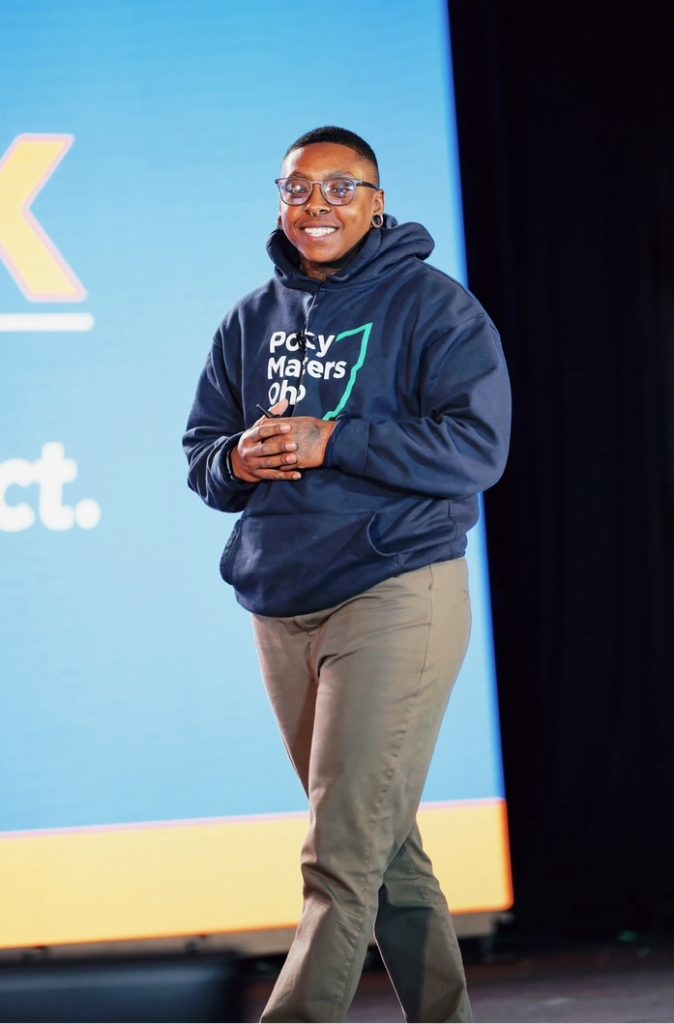
In 2024, Policy Matters Ohio surveyed marginalized communities to gauge and describe their reactions to first responders and law enforcement as they launched a non-police crisis response program called CARE.
The Policy Matters survey was meant to assist the ADAMHS Board of Cuyahoga County in shaping the CARE program. Easterling led the second phase of this survey to specifically get data on the intersections of youth who identify in categories of being unhoused, a part of the LGBTQ+ community and BIPOC communities.
Responses from the survey varied widely regarding interactions respondents had with law enforcement and first responders.
The report includes accounts from 580 people who shared their experiences with emergency medical services, police, firefighters and social workers, as reported by Signal Cleveland. Forty-eight percent said they had “very positive” or “positive” interactions with a first responder. Thirty-one percent scored their interactions as “neutral,” and 21% described them as “negative” or “very negative.”
“I told them multiple times that I am trans,” wrote one survey respondent. “When the officer patted me down, (they) continuously grabbed my crotch and other places, saying, ‘Something’s not right.’”
In other situations, people said they felt they received assistance in the moment of crisis. The police “helped me find a shelter that would take me with AIDS/HIV,” wrote one respondent.
Easterling said getting such input is crucial.
“People who live on the margins and people who are the most impacted are often the least heard,” Easterling said. “That’s how we approached the survey — by lifting up the voices of people who have been directly impacted by this particular issue.”
First CALL
Even as Cleveland was developing its alternate response programs to comply with the consent decree, Cuyahoga County, which includes Cleveland, was building its own program now serving five Cleveland suburbs.
First CALL, which stands for Crisis Assistance and Local Linkage, sends teams of behavioral health clinicians and peer support staff to help people experiencing mental health distress and substance use disorders. The program serves Cleveland Heights, Shaker Heights, South Euclid, Richmond Heights and University Heights.
First CALL can be dispatched through 911, and operators send the most appropriate response based on each scenario. First CALL operates Monday through Friday from 10 a.m. to 6 p.m. A “follow-up” team of First CALL staff checks up on those who have recently been served by the crisis responders.
Annette Wallace, First CALL program coordinator, said the response is tailored to give proper care and assistance in volatile times.
“Automatically, we go, ‘What do you need?’” Wallace said. “I love to use this analogy: You go to the hospital for a broken leg. They discharge you with a whole bunch of things, you got to make these appointments. You got to do this, you got to do that. It’s the same thing in regards to our mental health. This person was in crisis. How are they supposed to navigate that?”
The follow-up team helps people overcome challenges to getting care, she added.
“We’re there to address maybe some of those barriers that come up.,” Wallace said.
Wallace stressed the teams really develop meaningful connections with people, and that goes a long way.
Both First CALL and the city of Cleveland have funding secured to continue the programs through 2025. But alternative response programs nationwide – including Eugene, Oregon’s gold standard CAHOOTS program – are shutting down or struggling to get funding.
Ultimately, experts in Cleveland and beyond say the perception of alternate response programs has evolved from being seen as “defunding the police” or “not real enforcement” to being recognized as important efforts for every citizen to be valued and their needs met.
Tyler Williamson is an Investigative Specialization graduate student at Medill. You can follow her on Instagram at @tyreports_.
Editor’s note, Aug. 19, 2025, 11 a.m.: This story has been updated to clarify Bree Easterling’s title and description. Easterling is a former disabled Air Force veteran who focuses on change in policy.