
By Emma Urdangen, Kaitlyn Luckoff and Payton Turkeltaub
Medill Reports
Americans are traveling to Guadalajara, Mexico, for facelifts that cost a fraction of U.S. prices and documenting every step on TikTok. In this episode, we follow David and Michelle, two patients who went viral after their surgeries, to uncover what it really feels like to go abroad for plastic surgery, from the hospital bed to the social media spotlight.
Transcript
Urdangen: The city of Guadalajara in western Mexico has been a tourist attraction for years. Things like the International Mariachi Festival and the city’s International Book Fair have been a draw for out-of-towners. But recently, people have been flocking to the landlocked city for a different reason: plastic surgery.
Guadalajara is quickly becoming a top spot for facelifts, offering dramatic results at a fraction of U.S. prices. For people unwilling, or unable, to pay $30,000-plus in the U.S., Guadalajara offers an alternative — often with luxurious clinics and personalized care. But what does it look like to travel internationally to completely transform yourself? And how does it feel to come back and share your results with millions of people on social media?
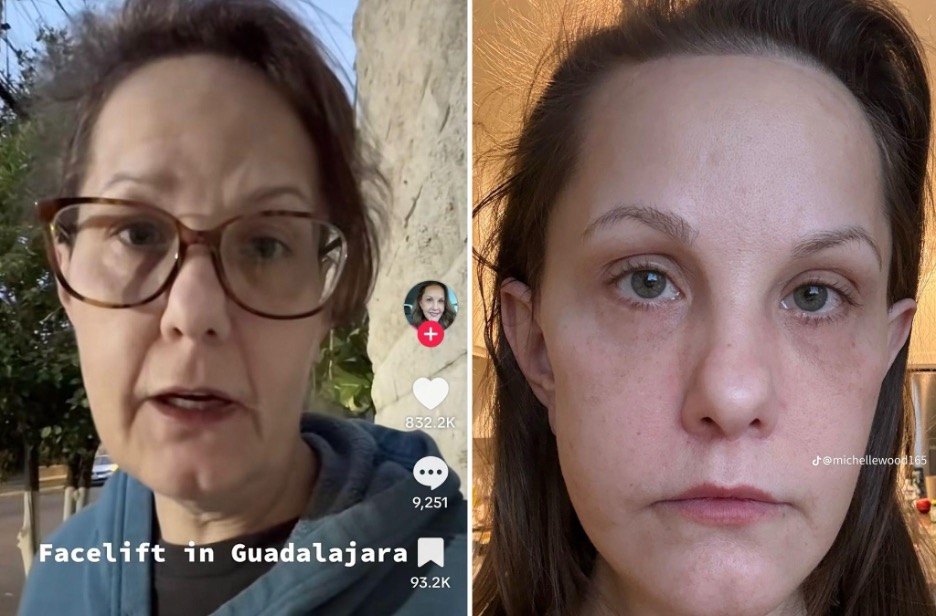
You might recognize David Dickson and Michelle Wood from their viral TikTok videos documenting their own facelift experiences. Or if you’d seen them before the surgery, you might not.
[TikTok clip introducing Wood]
“Good morning. My name is Michelle. I am documenting my journey here in Guadalajara. I am down here to look more refreshed and feel more refreshed.”
[TikTok clip introducing Dickson]
“Hello. Just wanted to jump on and introduce myself. I’m David … I had surgery last July. I had a lower face lift, upper lower bleph (blepharoplasty), neck lift, earlobe reduction.”
Urdangen: This is what it’s really like to get that facelift – and then go viral.
[Hospital monitor sound]
Urdangen: More than 1 million Americans travel to Mexico each year for plastic surgery at a discount. These lower costs tend to be associated with lower anesthesia and operating room fees. However, American doctors are hesitant to recommend surgery abroad because of the recovery risks.
According to the American Society of Plastic Surgeons, patients who have plastic surgery complications in a developing country can experience pain, infections and wound issues. A Charlotte Plastic Surgery Center reported that in patients with complications from plastic surgery in Mexico, 50% had infections.
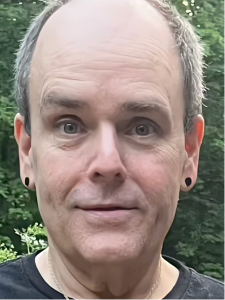
Those numbers didn’t stop David, though, who traveled to Guadalajara three years ago for a facelift.
Dickson: I’ve been seeing a lot of American doctors come on making videos about the dangers of traveling to Mexico, out of the country, because of follow-up care and things of that nature. But it’s kind of funny. A lot of these doctors are located in different states. You know, they said, ‘Well, I’m here in California, but we have patients in Georgia.’ I’m like, OK, what’s the difference? I live in Georgia right now. It’s a four-hour flight to California. So if I have to go to California from Georgia, what’s the difference with me taking that flight and versus me taking a flight, a three-hour flight, to Guadalajara.
Urdangen: At 55, David had lost 100 pounds and no longer recognized himself in the mirror – and not in a good way.
Dickson: I had a lot of extra skin hanging. I had what they call the famous waddle, and it was really bothering me because, you know, looking in the mirror did not reflect what I was feeling on the inside, so it caused a lot of emotional stress for me, I’ll say.
Urdangen: So, David started looking into getting a facelift. Quickly, though, he realized he wouldn’t be able to afford the procedure in the US.
Dickson: It was easily going to cost me $30,000, and that was not including airfare, aftercare or anything. So I’ll be honest, I knew having a facelift here in the States was not going to be an option for me and my family.
Urdangen: So, David looked abroad. After doing some research online, he found a surgeon in Guadalajara who specializes in deep plane facelifts, which lift the muscle and tissue rather than just the skin. And while the cost of deep plane facelift generally ranges from $20,000 all the way to $100,000 in the U.S., David paid just $9,000 for his procedures.
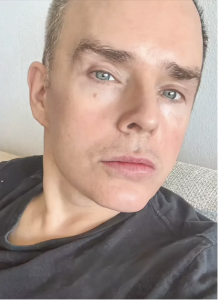
Dickson: I had a lower facelift, upper and lower bleph, ear lobe reduction, I had a CO2 laser resurfacing and a neck lift.
Urdangen: Michelle was like David. Except, by the time she was 51, she’d lost more than 100 pounds twice throughout her life. The final time did a number on her skin, especially her face. And after discussing potential options like filler with her injector, she realized what she really needed was a facelift.
Wood: I looked inside the States, and the cost was just unattainable for what I wanted. I wanted the best that my money could afford, right? So in the States, even if I had spent $30,000, that’s just the facelift. That’s not the eyes, that’s not anything else, that’s your face and neck, period. And I knew I wasn’t willing to spend that much money, nor did I have that much money.”
Urdangen: Michelle had never been opposed to plastic surgery. In the past, she even had skin removal surgery in Tijuana. So, traveling for a procedure wasn’t foreign to her. After doing some research on potential surgeons in Tijuana, Michelle ultimately decided to go with a surgeon in Guadalajara, who’d been highly recommended by a friend.
Wood: I quickly scheduled a consult with her, and it was a video consult, and I felt completely comfortable and at ease with her, and that’s what led me to decide on her as my surgeon.
Urdangen: And while for most, traveling internationally might sound like a big undertaking, for David and Michelle, the benefits outweighed the risks.
Dickson: You know, plastic surgery, any kind of surgery here, even in the States, you have your, unfortunately, your things have happened, you know, and it’s a tragic kind of thing when it does, but, you know, it happens everywhere. You just have to do your due diligence.
[Hospital noise transition]
Urdangen: Michelle and David both went to the same surgeon, Dr. Maribel Belmontes, who practices out of the San Javier Medical Center, a private hospital in Guadalajara.
Wood: It almost felt like a hotel, like, you know, you walk into a hotel lobby and it’s gorgeous, same thing. So, the hospital in Guadalajara, you walk in, there’s huge plants, chandeliers from the ceiling, clean, clean, clean. Not a lot of patients just standing around waiting. … It was beautiful and very calming.
Dickson: The surgery center, honestly, just felt like a resort to me. I mean, honestly it did.
Urdangen: And even though there was a bit of a language barrier, the patients found ways around it.
Wood: There was some difficulty communicating, nothing that Google Translate didn’t handle, and it was totally fine, right?
Urdangen: After a pre-operative consultation to go over the exact plan, it was time for surgery.
Wood: They took me into the operating room. They had me, you know, switch from that bed to the table, and that is all I remember. I don’t remember putting a mask on me, you know, sometimes you’ll remember kind of counting backwards, none of that. It was just like that.
[Hospital noise transition]
Urdangen: Michelle’s surgery took a little less than seven hours in total with no complications. After one night in the hospital, Michelle moved to a treatment center in the area, where she recovered for another few days. At this point, that certainty Michelle felt when she got on the plane to Guadalajara, well, it started to waver.
Wood: I was regretting my life choices at that time. I was like, what in the hell did I just do? Like, why? Why did you do this? This is awful. I want my mom, you know, I regretted every decision I had made in my life up to that point, almost. I felt kind of like a Bratz doll. You know how they look, kind of round-faced, and round faced, I couldn’t recognize myself.
Urdangen: It’s not unusual to have these feelings post-op, surgeons say. Procedures like these can take six weeks to heal and another six months to see the final results. Michelle and David will tell you that the physical healing is just one part of the process. The mental adjustment, becoming acquainted with a new face, can bring its own set of challenges.
Dickson: I’m a stay-at-home dad, so once I got back home, I was by myself a lot. And you go through a lot of changes because at the time, you know you’re swollen, you know you’re sitting around by yourself. You don’t have the staff, you know, talking to you, reassuring you this and that and the other. So, you know, I started like, looking at myself thinking, oh my gosh, my face looks lopsided, you know. So I started filling up all these medical anxieties. So I, yeah, I went through a tad bit of depression, and then I’ve since discovered that that’s common for some people.
Wood: And I do think that there’s a certain amount of body dysmorphia that I have just from my past. I’ve never looked like this. I would see myself in the mirror and think, ‘Who are you?’ My one son, when they picked me up from the airport, said, ‘No offense, Mom, but your skin looks like it’s about to split open.’ But my other son, as the swelling has gone down, he’s like, ‘I think you now look more like me than ever, Mom.’
Urdangen: Today, Michelle and David are both thrilled with their results, so much so that they’ve both documented their entire healing process on TikTok, starting after they returned from Mexico.
Wood: I thought, you know, I’m just gonna document my experience, and maybe a couple of people will watch it, and maybe it helps them make a decision on not being afraid to go outside of the country to get care. So I started documenting. I posted a couple of videos while I was in Guadalajara, and then I got home, and I was talking to a former co-worker, a friend, and she called me one morning. She’s like, “Dude, I think you’re going viral.” And I was like, “Shut the hell up.”
Urdangen: Sure enough, Michelle was going viral. Her videos have been viewed well over 100 million times, and were covered by news outlets like E!, BuzzFeed and MSN. Slate called it “the most famous facelift on TikTok.” But as you might expect, commenters had a lot to say about their result.
[TV glitch sound]
Clip from TikTok: “It is wild how good she looks.”
Clip from TikTok: “There is a lady on here who got a facelift in Guadalajara, and it’s so good I’m actually scared.”
[TV glitch sound]
Wood: I’ve had great reception from a lot of people. I would say the vast majority. There are people out there that are just [bleep]holes. They are. And I call them on it, because, I don’t think you would ever say that kind of thing to somebody face to face, right? Like, why, why do you feel the need to be cruel or mean? If you don’t like something, why are you watching it? Just scroll.
Urdangen: Regardless of anyone else’s opinions, Michelle and David say the ability to access a procedure like this can be life-changing.
Wood: I feel more confident. There’s no doubt about that. I feel beautiful. I don’t think I ever felt beautiful before, certainly not in the American sense of the word, right?
Dickson: I just feel like my old self, you know, my confidence is back. Yes, I’m 56, but I feel great at 56, you know. I no longer feel looking at me because of all the excess skin or sagginess or whatever. I feel like people are looking at me just for who I am. And I know that it’s more of a psychological thing, for sure, but yeah, I’m over the moon now.
Urdangen: Looking ahead, David is planning on returning to Mexico for a rhinoplasty, also known as a nose job, a fat transfer and two additional cosmetic procedures.
Dickson: I’m just going all out for it, like I hit a certain age. I’m like, why not? If it’s going to make you happy.
Emma Urdangen, Kaitlyn Luckoff and Payton Turkeltaub are recent graduates of Northwestern’s Medill School of Journalism. You can find more of their work at emmaurdangen.com, https://kaitlynluckoff.journoportfolio.com and https://www.paytonturkeltaub.com.