
By Autumn Coleman
Medill Reports
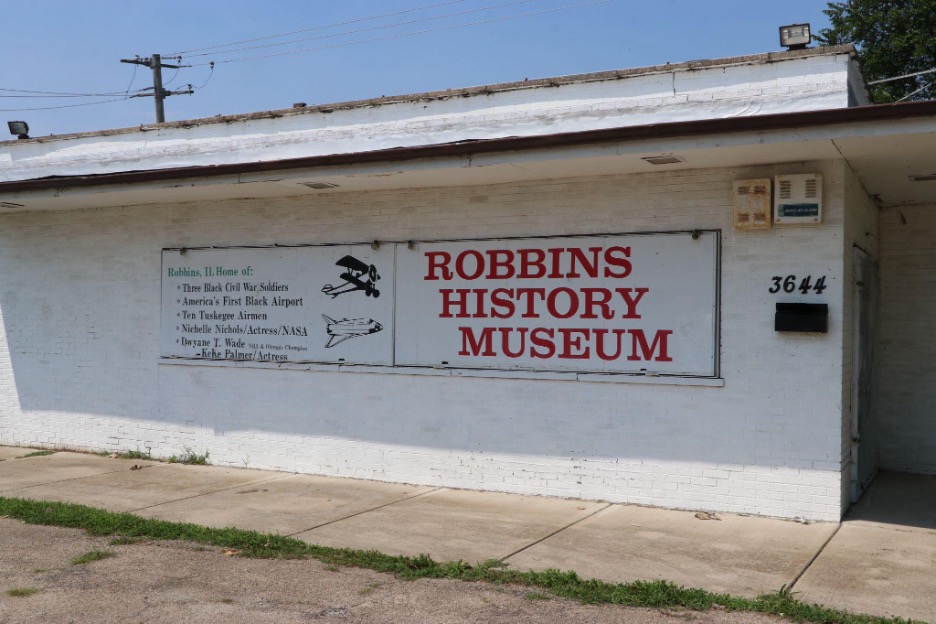
In 2019, Dawn Colquitt-Anderson walked into her small hometown’s history museum with her 8- and 9-year-old nieces in tow. She expected to find family photos and fun facts, but she discovered memorabilia of Tuskegee Airmen and Black cowboys. The information sent Colquitt-Anderson on an ongoing journey to spread the almost-forgotten past of Robbins, Illinois.
“When I visited the museum and realized that there was all this history I didn’t know about my own hometown,” Colquitt-Anderson said, “I was like, ‘Wait a minute.’”
Colquitt-Anderson is the museum’s newly appointed director as of September, following the recent death of Tyrone Haymore, former founder and curator. Haymore spent his life educating people about Robbins’ history as the first all-Black town in the North. To prepare for her new role, Colquitt-Anderson would like to move to a new, bigger location and develop a free youth education curriculum for teachers to use in the classroom.
“People come in who don’t value the story,” Colquitt-Anderson said. “We want to make sure that they value the story. That’s what my museum work is about.”
Colquitt-Anderson has already begun the process of analyzing impacts of introducing the information to local children.
Incorporated in 1917, Robbins has been home to pilots, veterans, actresses, athletes and activists. The suburb began as one of the only places where Black families could own land and property in the greater Chicago area. Once a stop on the Underground Railroad, Robbins was a place where Black people settled in the North during the Great Migration in their search for economic and social freedom.
Ten of the 992 members of the most well-known group of African American pilots — the Tuskegee Airmen — called Robbins their home. In 1931, the Robbins Airport became known as the first all-Black airstrip. Due to Jim Crow laws and social attitudes, many African American pilots were arrested by the police of neighboring towns for landing planes in Robbins. Their release came at the majority-Black Robbins police department.
The school and landing strip existed for two years before being destroyed by a storm. Black pilots like Bessie Coleman, the first African American woman to hold a pilot license, were integral to its success, despite not being from Robbins.
“It was sad at first when I realized that it used to be a Black-owned place,” said Trayvon Bradford, a Robbins resident, of the formerly thriving village. “I don’t know what happened for it to get torn down like this, but I can see that we’re in the stages of rebuilding.”
After the process of integration following Brown v. Board of Education in 1954, the self-sustaining village began to lose vital members.
S.B. Fuller, a cosmetics entrepreneur and formerly the richest Black man in America, urged Black people to go into business for themselves. Fuller, who owned a house in Robbins, died in 1988.
In 2015 the Fuller family donated his home to the Robbins Historical Society. The property has fallen into disarray after being vacant for years, but the Robbins History Museum on 139th Street plans to renovate Fuller’s house to hold its collection of village artifacts, including hats, shoes and pictures from the Lattings family. Museum Director Colquitt-Anderson said the location is expected to become the museum’s new home once the Robbins Historical Society receives $200,000 for renovations.
“This incredible architecture of a house that he built, they want to get rid of it ..,” Colquitt-Anderson said. “So now our job of making sure that these stories are preserved is also for when those newer people come in who don’t value the story. We want to make sure that they learn the story and that they value it.”
The 1.4-square-mile village of Robbins was home to “Star Trek” star Nichelle Nichols, who made history as the first Black woman to kiss a white man on television, basketball hall of fame inductee Dwyane Wade and Laurence “Mr. T” Tero. Nichols’ father, Samuel Nichols, was the town’s mayor from 1929 to 1930. His brief time in office is most known for the story of Al Capone threatening his life over a false accusation of stealing.
The youngest of the celebrities from Robbins is 31-year-old actress Keke Palmer, whose mother is also from the small town. Her father, Larry Palmer, who now lives in Grenada Hills, California, says Robbins’ Black Catholic church welcomed his daughter’s talents.
“Nothing makes you successful just because other successful people are from there,” Larry Palmer said. “It’s just good to know that you have people from your hometown who have been successful in entertaining the way you have.”
During a period of opportunity for Black people in America, Robbins became known as a town that exemplified African American self-reliance. Marcus Garvey, a Pan-African activist, chose the village as the site for his Chicago-area rallies because of the thriving all-Black community. Economically, Robbins has changed. Many Black business owners who brought money into the community left or died. Their buildings have stayed as many residents live in family homes that have been passed down. The home ownership rate: 65%.
The lived reality for Robbins residents is only experienced by 44.3% of Black Americans nationwide as of 2024, according to the Urban Institute.
“Owning land, having Black neighbors, being in a community governed by our people was a very self-affirming and prideful thing because even in Chicago there was residential segregation,” said Gerald McWorter/Abdul Alkalimat, professor emeritus of African American studies at University of Illinois, Urbana-Champaign.
Robbins today is a far cry from the town’s heyday in the mid-20th century, but pride for the small village comes from current and former residents who have learned of its past. In 2021, Darren Bryant made Illinois history as the youngest African American mayor at 29. Under Bryant, Robbins has begun to change. In 2023, he was named “Mayor of the Year” by a local community organization, From the Roof Down, for bringing development to a town that has stayed remarkably the same for more than 50 years.
Until recently, Robbins had been known for its slew of government violations. In 2021, the EPA hit the village with multiple infractions for aging infrastructure. The mayor has since called on federal funding to aid in repairs. Many residents wonder why there hasn’t been more money given to the community to help solve systemic problems.
“The citizens deserve a municipality that works for them,” Village Clerk Sharon Dyson said. “I feel like I’m here for a purpose. I do have an effect on my citizens. I see that and I know it. I feel good when I can make a difference, and I can help a citizen.”
Autumn Coleman is a recent graduate of Northwestern’s Medill School of Journalism.