
By Sydney Meyer
Medill Reports
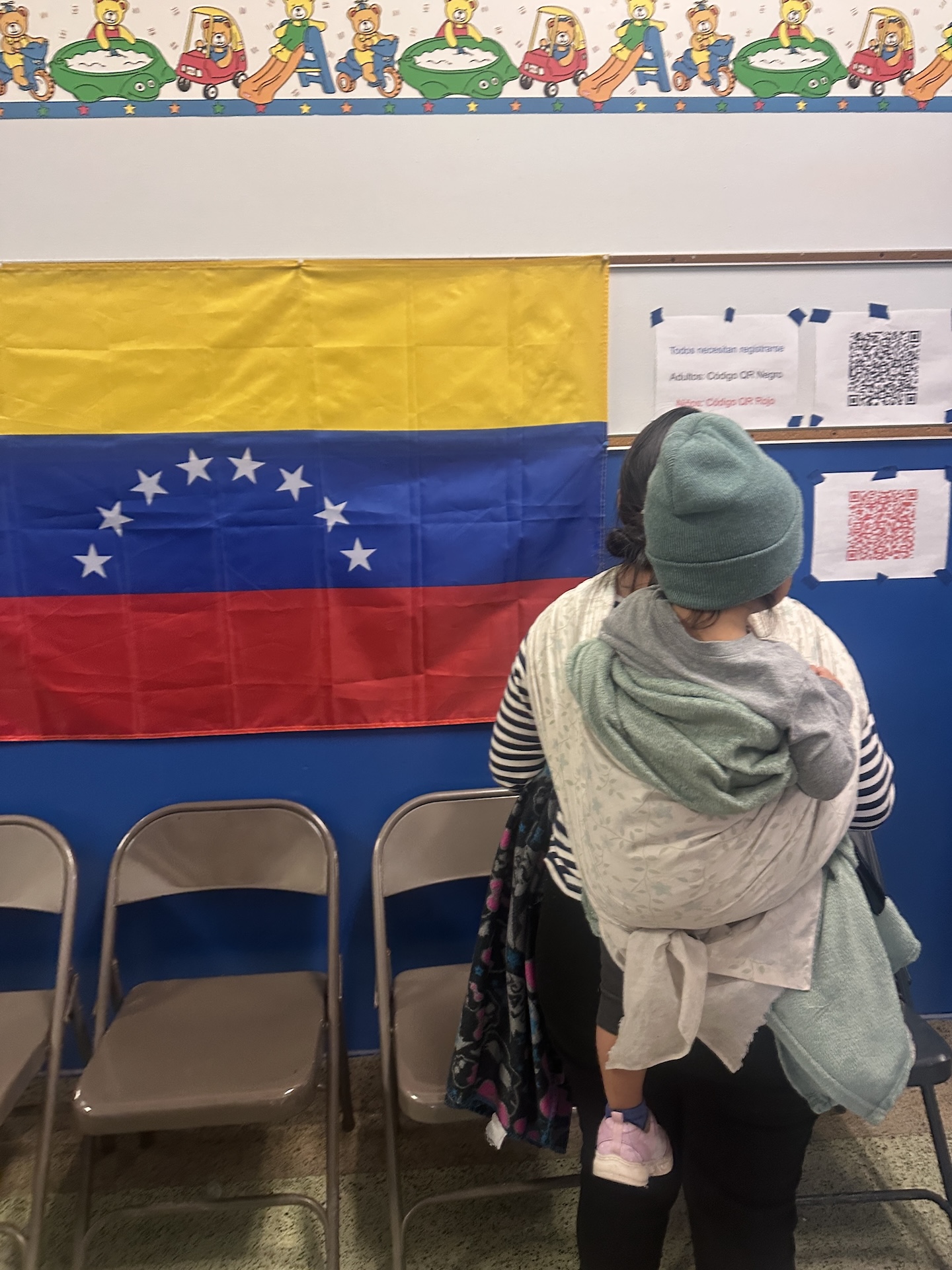
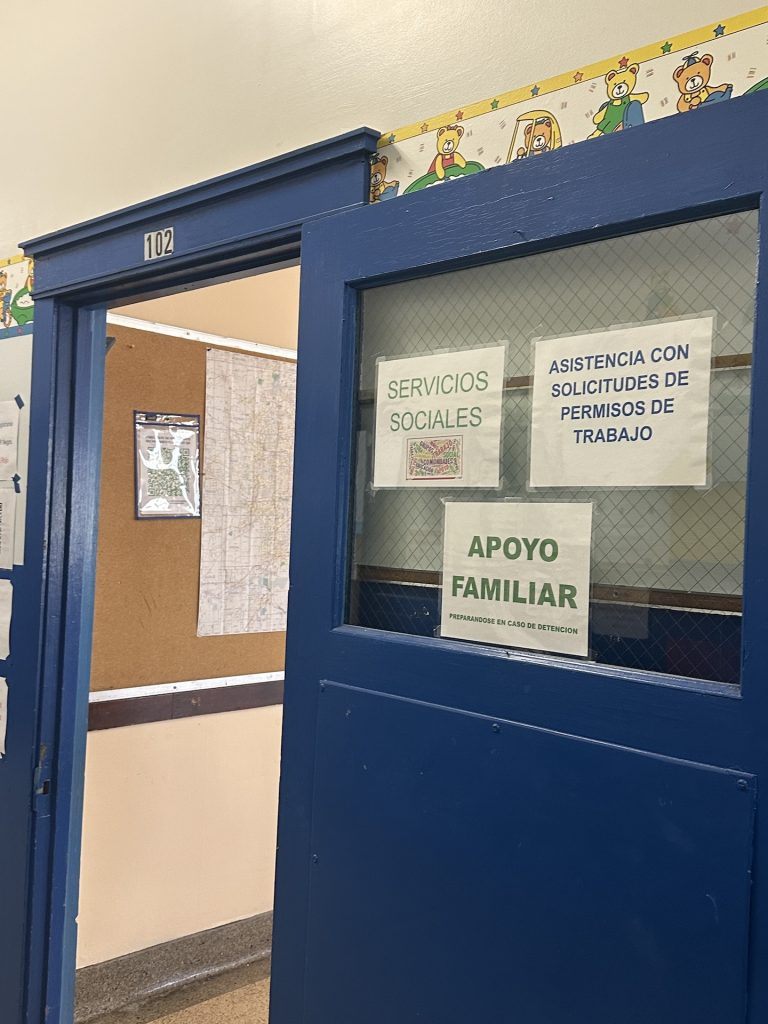
At 7 a.m. on a chilly Tuesday in February, Celine Woznica, a former Maryknoll missioner in Nicaragua and Mexico and longtime Oak Park resident, entered the side door of the abandoned St. Bernardine School, a Catholic elementary school in Forest Park, Ill. She climbed a set of stairs leading to a long hallway that has been transformed into what she now calls “Centro San Bernardino.” Latin American flags hang alongside brightly painted classroom doors and wallpaper featuring teddy bears. Inside classrooms, desks have been replaced with racks of donated clothes. At the end of the hall, a sign designates a room with a blue door as “APOYO FAMILIAR,” meaning “family support.” In smaller print below, the sign specifies, “PREPARÁNDOSE EN CASO DE DETENCIÓN,” or “preparing in case of detention.”
Woznica has made more signs, in English, for volunteers to hold just in case U.S. Immigration and Customs Enforcement stop by. They read, “We will remain silent.”
“You can never be too careful,” Woznica said.
Woznica started Migrant Ministry – an interfaith volunteer network composed mostly of retired, religiously affiliated western suburbanites – in fall 2022, when there was little talk of detention, deportation or ICE. Sponsored by Woznica’s home parish, The Catholic Communities of Oak Park, it was initially a short-term charity response to the surge of Latin migrants arriving in Chicago. Today, the Migrant Ministry has evolved into a full-blown advocacy group with more than 35 weekly volunteers.
“I think some of it has to do with the general age of the volunteers,” said Susan Morrissey, 78, who has taught English at the Migrant Ministry since 2022. “We remember the ’60s. We have a lot of real protesters and hippies. Now they’re all gray-haired folks, but they have that activism-attitude.”
In May 2023, Texas Gov. Greg Abbott had been busing migrants from Texas to Chicago for almost nine months. The newly-arrived were spilling out of police stations all over the city, so Woznica joined a local police station response team and organized for those sleeping at the Austin station to take showers at her local church’s rectory.
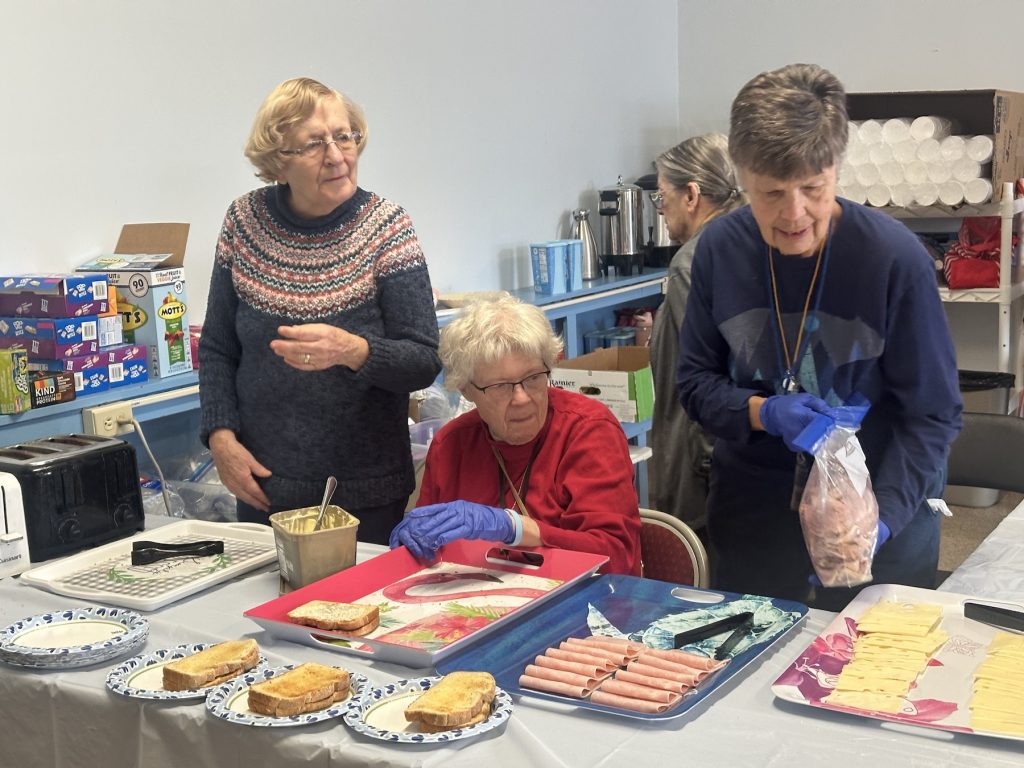
Along with other volunteers, Woznica began distributing food, clothes and bedding Tuesday and Thursday mornings from St. Edmunds, another closed neighborhood Catholic school. Eventually, they began to also host English as a Second Language lessons, work permit assistance, a children’s play area and drop-in hours from a nearby social services agency. Woznica attributed their scope to flexible schedules. “Ninety percent of us are retired, OK? And the average – I’m not kidding – the average age is like mid- to late 70s,” Woznica laughed.
It wasn’t long before word spread throughout the city’s migrant communities. “They were coming from all over Chicago,” Woznica said. At its peak in early 2024, she estimated the Migrant Ministry was seeing as many as 500 migrants within just two days of service each week.
Then Donald Trump, who vowed during his campaign to launch the largest deportation campaign in American history, was reelected.
Migrant Ministry’s volunteers began to anticipate the immigration landscape they first encountered in 2022 had not aptly prepared them for what was to come. “I created a rapid response plan,” Woznica said. “We started when (Trump) was elected. We had it reviewed by lawyers.”
By the time Operation Midway Blitz — Trump’s 2025 mass deportation campaign in Chicago — was underway, it was obvious the Migrant Ministry’s mission was directly at odds with the federal government.
Volunteers positioned themselves outside St. Barnardine with walkie-talkies to keep watch for ICE. Migrant Ministries hosted Know Your Rights training sessions so members understood how to navigate harboring laws, or how to tell if an agent presented them with a valid or invalid warrant. They passed out whistles, Know Your Rights Cards and wristbands with an ICE watchdog organization’s number printed on them.
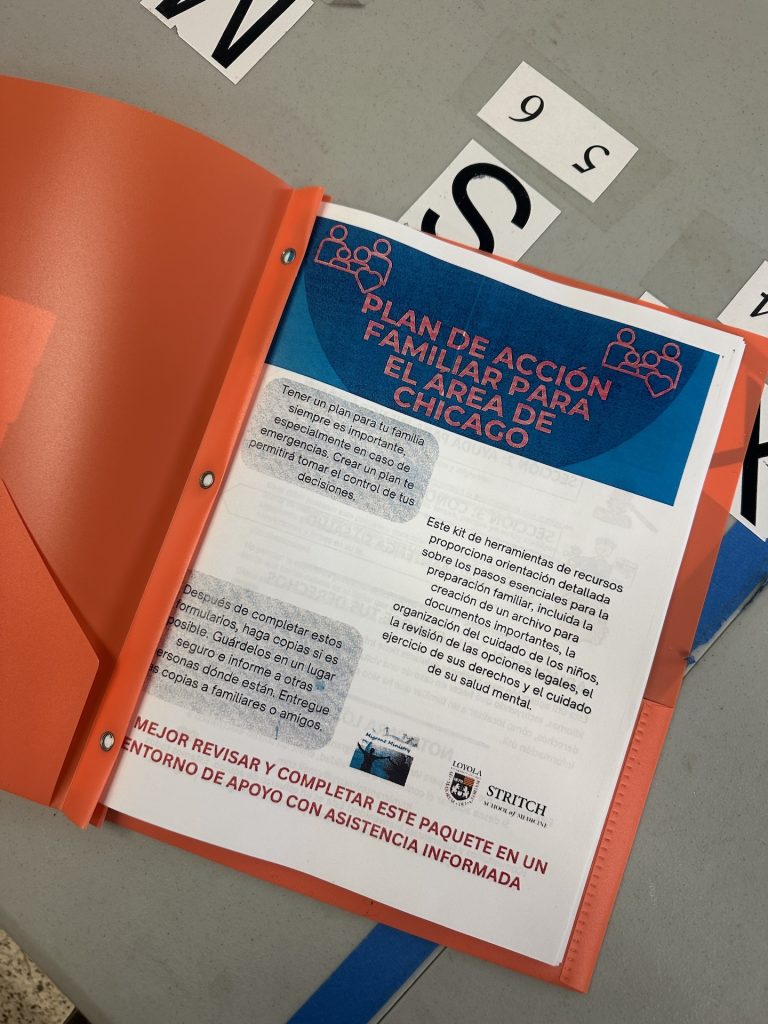
Woznica also worked on a recent initiative — Migrant Ministry’s Family Action Plan — a packet with a series of tips and forms designed to help refugees prevent arrest, (“Avoid traffic stops”), and prepare in case of detention (“Make sure at least one trusted person memorizes your A-Number,” the identification number assigned by the U.S. government to non-citizens). Also included is a form from the Department of Children and Family Services titled, “Appointment of Short-Term Guardian,” through which parents designate who will be responsible for their children if they’re taken by ICE.
“It’s very difficult,” Woznica said. “I mean, you’re talking about temporary custody of their child.”
“(The goal) was to launch them to self-sufficiency,” said Steve Raseman, a member of St. Anne’s Catholic Church in Barrington, Ill., who coordinates with the Migrant Ministry. But with Trump’s reelection, “Now they can be detained, they can be deported. Just lots of huge obstacles that we didn’t anticipate.”
Their tactics as a group have expanded since 2022. Volunteers regularly attend protests and prayer services outside the federal ICE detention center in Broadview. Others have begun meeting with elected officials. Woznica explained their perspective by describing an image she saw at a protest: “It was Our Lady of Guadalupe, and she’s not like this,” said Woznica, looking down and pressing her hands together in prayer at her chest. “She’s like this,” Woznica raised her chin high and held her right hand up in a fist.
To Woznica, and other members of Migrant Ministry, this image encapsulates the ministry’s mission of investing in the political needs of Chicago’s migrant community, along with their material and spiritual needs.
“It started out as a charity, but it very quickly morphed,” said Madonna Thelen, 77, a longtime volunteer in the breakfast room. “It’s also organizing for advocacy, engaging in protests, having letter-writing campaigns to our senators and Congress people.”
Woznica outlines the ministry’s next challenge: accompanying the detained. This includes court witnessing, teaching families to track detained individuals and retrieving individuals who are transported and released out of state back to Chicago.
“This is about human dignity,” Woznica said. “It’s a new way of church. It’s a new way of being church.”
Throughout all the iterations of the Migrant Ministry over the past three and a half years, Woznica is adamant there was no hesitation to adapt. And they have no plans to slow down.
Sydney Meyer is a magazine specialization graduate student at Medill.